Which of the following is the most immediate source of energy for making most of the ATP in your cells?
a. the transfer of from intermediate substrates to ADP
b. the movement of H+ across a membrane down its concentration gradient
c. the splitting of glucose into two molecules of pyruvate
d. electrons moving through the electron transport chain
Guida verificata passo dopo passo
1
Identify the process in cellular respiration where ATP is primarily produced.
Recall that ATP is mainly produced during oxidative phosphorylation.
Understand that oxidative phosphorylation involves the electron transport chain and chemiosmosis.
Recognize that the movement of H+ ions across the mitochondrial membrane creates a proton gradient.
Conclude that the movement of H+ ions down their concentration gradient through ATP synthase is the immediate source of energy for ATP synthesis.
Risposta video verificata per un problema simile:
Questa soluzione video è stata consigliata dai nostri tutor come utile per risolvere questo problema.
Durata del video:
2m
Guarda un video:
0 Commenti
Concetti chiave
Ecco i concetti essenziali che devi comprendere per rispondere correttamente alla domanda.
ATP Synthesis
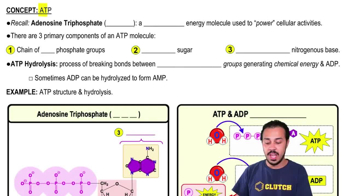
ATP (adenosine triphosphate) is the primary energy carrier in cells. Its synthesis occurs mainly through oxidative phosphorylation, where energy from electrons is used to convert ADP and inorganic phosphate into ATP. Understanding the mechanisms of ATP production is crucial for answering questions about cellular energy sources.
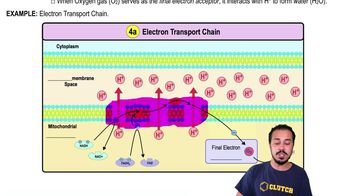
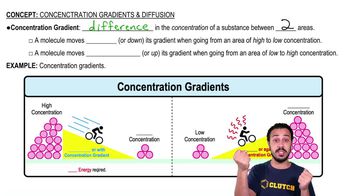
The movement of H+ ions (protons) across a membrane creates a proton gradient, which is essential for ATP synthesis. This gradient drives ATP synthase, an enzyme that produces ATP as protons flow back into the mitochondrial matrix. Recognizing the role of the proton gradient is key to understanding how energy is harnessed in cellular respiration.
The electron transport chain (ETC) is a series of protein complexes located in the inner mitochondrial membrane that transfer electrons derived from nutrients. As electrons move through the ETC, they release energy used to pump protons across the membrane, contributing to the proton gradient necessary for ATP production. Familiarity with the ETC is vital for comprehending cellular energy dynamics.

 2:18 minuti
 Guida verificata passo dopo passo
 04:51
04:51