Which of the following occurs when a covalent bond forms?
a. Electrons in valence shells are transferred from one atom to another.
b. Electrons in valence shells are shared between atoms.
c. Partial charges on polar molecules interact.
d. Nonpolar molecules are pushed together.by surrounding water molecules.
Guida verificata passo dopo passo
1
Identify the type of bond being discussed in the problem, which is a covalent bond.
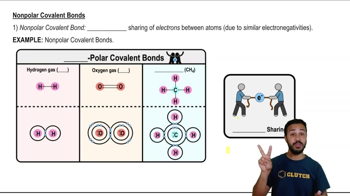
Recall the definition of a covalent bond: it involves the sharing of electrons between atoms.
Consider each option provided in the problem and determine which one aligns with the definition of a covalent bond.
Option a describes electron transfer, which is characteristic of ionic bonds, not covalent bonds.
Option b describes the sharing of electrons, which matches the definition of a covalent bond.
Risposta video verificata per un problema simile:
Questa soluzione video è stata consigliata dai nostri tutor come utile per risolvere questo problema.
Durata del video:
1m
Guarda un video:
0 Commenti
Concetti chiave
Ecco i concetti essenziali che devi comprendere per rispondere correttamente alla domanda.
Covalent Bonding
Covalent bonding occurs when two atoms share one or more pairs of electrons in their outermost shells, known as valence shells. This sharing allows each atom to attain a more stable electronic configuration, often resembling that of noble gases. Covalent bonds can be single, double, or triple, depending on the number of shared electron pairs.
Valence electrons are the electrons located in the outermost shell of an atom and are crucial for chemical bonding. The number of valence electrons determines how an atom interacts with others, including whether it will form covalent bonds by sharing electrons or ionic bonds by transferring electrons. Understanding valence electrons is essential for predicting the behavior of elements in chemical reactions.
Molecules can be classified as polar or nonpolar based on the distribution of electrical charge. Polar molecules have an uneven distribution of charge, leading to partial positive and negative charges, while nonpolar molecules have an even distribution. This distinction is important in understanding interactions between molecules, such as how polar molecules interact with water and how nonpolar molecules behave in aqueous environments.

 1:58 minuti
 Guida verificata passo dopo passo
 04:28
04:28