MAKE CONNECTIONS The proton pump shown in Figures 7.17 and 7.18 is a type of ATP synthase (see Figure 9.14). Compare the processes shown in the two figures, and say whether they are involved in active or passive transport (see Concepts 7.3 and 7.4).
Guida verificata passo dopo passo
1
Review Figures 7.17 and 7.18 to understand the structure and function of the proton pump depicted.
Examine Figure 9.14 to identify the ATP synthase and its role in cellular processes.
Compare the mechanisms of the proton pump and ATP synthase, focusing on how they move protons across membranes.
Determine whether the proton pump and ATP synthase are examples of active or passive transport by considering if they require energy input (ATP) or utilize a concentration gradient.
Refer to Concepts 7.3 and 7.4 to clarify the definitions and examples of active and passive transport, and apply these definitions to the processes in the figures.
Risposta video verificata per un problema simile:
Questa soluzione video è stata consigliata dai nostri tutor come utile per risolvere questo problema.
Durata del video:
1m
Guarda un video:
0 Commenti
Concetti chiave
Ecco i concetti essenziali che devi comprendere per rispondere correttamente alla domanda.
ATP Synthase
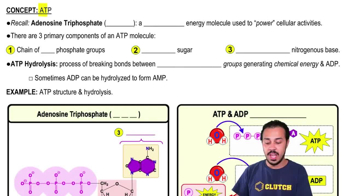
ATP synthase is an enzyme that catalyzes the formation of adenosine triphosphate (ATP) from adenosine diphosphate (ADP) and inorganic phosphate. It plays a crucial role in cellular respiration and photosynthesis, utilizing a proton gradient to drive the synthesis of ATP. This process is essential for energy transfer within cells.
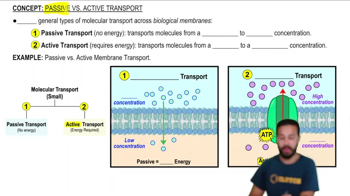
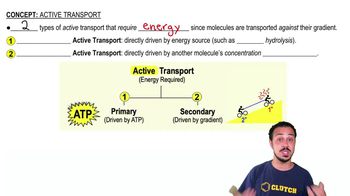
Active transport is the movement of molecules across a cell membrane from a region of lower concentration to a region of higher concentration, against the concentration gradient. This process requires energy, typically in the form of ATP, to function. It is vital for maintaining cellular homeostasis and nutrient uptake.
Passive transport refers to the movement of molecules across a cell membrane without the use of energy, occurring along the concentration gradient. This includes processes such as diffusion and osmosis, where substances move from areas of higher concentration to lower concentration. It is essential for the regulation of substances within cells.

 1:18 minuti
 Guida verificata passo dopo passo
 02:37
02:37