MAKE CONNECTIONS Step 3 in Figure 9.9 is a major point of regulation of glycolysis. The enzyme phosphofructokinase is allosterically regulated by ATP and related molecules (see Concept 8.5). Considering the overall result of glycolysis, would you expect ATP to inhibit or stimulate activity of this enzyme? Explain. (Hint: Make sure you consider the role of ATP as an allosteric regulator, not as a substrate of the enzyme.)
Guida verificata passo dopo passo
1
Identify the role of phosphofructokinase in glycolysis: it catalyzes the conversion of fructose-6-phosphate to fructose-1,6-bisphosphate.
Understand that ATP acts as an allosteric regulator for phosphofructokinase, not just as a substrate.
Consider the overall result of glycolysis, which is the production of ATP.
Recognize that high levels of ATP indicate that the cell has sufficient energy, which would signal the need to slow down glycolysis.
Conclude that ATP would inhibit the activity of phosphofructokinase to prevent overproduction of ATP and conserve resources.
Risposta video verificata per un problema simile:
Questa soluzione video è stata consigliata dai nostri tutor come utile per risolvere questo problema.
Durata del video:
3m
Guarda un video:
0 Commenti
Concetti chiave
Ecco i concetti essenziali che devi comprendere per rispondere correttamente alla domanda.
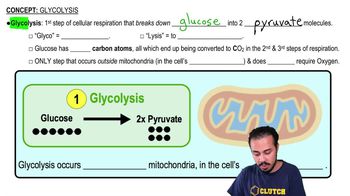
Glycolysis
Glycolysis is a metabolic pathway that converts glucose into pyruvate, producing ATP and NADH in the process. It consists of ten enzyme-catalyzed reactions and is crucial for cellular respiration. The pathway is divided into two phases: the energy investment phase, where ATP is consumed, and the energy payoff phase, where ATP is produced. Understanding glycolysis is essential for analyzing how energy is generated in cells.
Allosteric regulation refers to the modulation of an enzyme's activity through the binding of an effector molecule at a site other than the active site. This can lead to conformational changes that either enhance or inhibit enzyme activity. In the context of phosphofructokinase, ATP acts as an allosteric inhibitor, signaling that energy levels are sufficient and reducing the enzyme's activity to prevent excessive glycolysis.
Phosphofructokinase (PFK) is a key regulatory enzyme in glycolysis that catalyzes the conversion of fructose-6-phosphate to fructose-1,6-bisphosphate. It is considered the main control point of the glycolytic pathway. PFK is allosterically regulated by ATP, which inhibits its activity when energy levels are high, thus preventing the unnecessary breakdown of glucose when the cell does not require additional energy.

 3:26 minuti
 Guida verificata passo dopo passo
 05:04
05:04