Which of the following forms of membrane transport require specific membrane proteins?
a. diffusion;
b. exocytosis;
c. facilitated diffusion;
d. active transport;
e. facilitated diffusion and active transport
Guida verificata passo dopo passo
1
Identify the types of membrane transport listed in the options: diffusion, exocytosis, facilitated diffusion, and active transport.
Understand that diffusion is a passive process where molecules move from an area of higher concentration to an area of lower concentration without the need for membrane proteins.
Recognize that exocytosis is a form of bulk transport where materials are expelled from the cell, involving vesicles rather than specific membrane proteins.
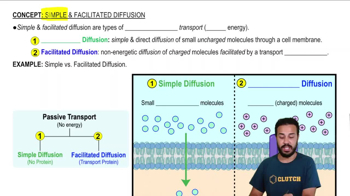
Facilitated diffusion is a passive transport process that requires specific membrane proteins, such as channels or carriers, to help move substances across the cell membrane.
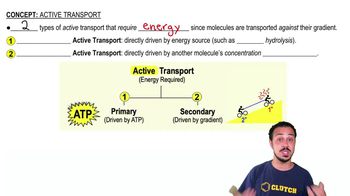
Active transport is an energy-dependent process that also requires specific membrane proteins, such as pumps, to move substances against their concentration gradient.
Risposta video verificata per un problema simile:
Questa soluzione video è stata consigliata dai nostri tutor come utile per risolvere questo problema.
Durata del video:
35s
Guarda un video:
0 Commenti
Concetti chiave
Ecco i concetti essenziali che devi comprendere per rispondere correttamente alla domanda.
Membrane Transport
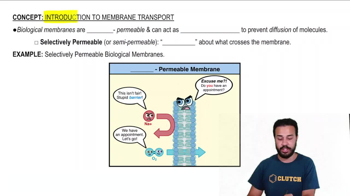
Membrane transport refers to the mechanisms by which substances move across the cell membrane. This process is crucial for maintaining cellular homeostasis and involves various methods, including passive and active transport. Understanding these mechanisms helps in grasping how cells interact with their environment and regulate internal conditions.
Facilitated diffusion is a type of passive transport that requires specific membrane proteins to help move molecules across the cell membrane. Unlike simple diffusion, which occurs directly through the lipid bilayer, facilitated diffusion utilizes carrier or channel proteins to assist in the transport of larger or polar molecules, ensuring they can enter or exit the cell efficiently.
Active transport is a process that moves substances against their concentration gradient, requiring energy, usually in the form of ATP. This transport is mediated by specific membrane proteins known as pumps. Active transport is essential for maintaining concentration differences of ions and molecules across the membrane, which is vital for various cellular functions.

 0:35 minuti
 Guida verificata passo dopo passo
 03:00
03:00