What are the reactants and products of cellular respiration?
Guida verificata passo dopo passo
1
Identify the main purpose of cellular respiration, which is to convert biochemical energy from nutrients into adenosine triphosphate (ATP), and then release waste products.
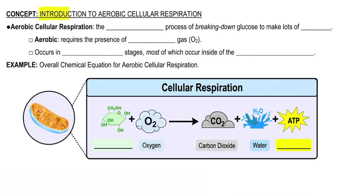
Recognize the primary reactants involved in cellular respiration: glucose (C6H12O6) and oxygen (O2).
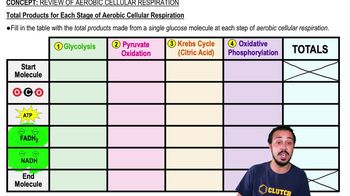
Understand that cellular respiration occurs in three main stages: glycolysis, the citric acid cycle (Krebs cycle), and oxidative phosphorylation.
Identify the main products of cellular respiration: carbon dioxide (CO2), water (H2O), and ATP.
Summarize the overall chemical equation for cellular respiration: C6H12O6 + 6O2 → 6CO2 + 6H2O + ATP.
Risposta video verificata per un problema simile:
Questa soluzione video è stata consigliata dai nostri tutor come utile per risolvere questo problema.
Durata del video:
1m
Guarda un video:
0 Commenti
Concetti chiave
Ecco i concetti essenziali che devi comprendere per rispondere correttamente alla domanda.
Cellular Respiration
Cellular respiration is a metabolic process that converts glucose and oxygen into energy, specifically ATP (adenosine triphosphate), which cells use for various functions. This process occurs in three main stages: glycolysis, the Krebs cycle, and the electron transport chain, each contributing to the overall energy yield.
The primary reactants of cellular respiration are glucose and oxygen. Glucose, derived from carbohydrates, serves as the main energy source, while oxygen is essential for the aerobic phase of respiration, allowing for the complete oxidation of glucose to produce energy efficiently.
The main products of cellular respiration are carbon dioxide, water, and ATP. Carbon dioxide is released as a waste product during the Krebs cycle, while water is formed during the electron transport chain. ATP is the energy currency of the cell, providing the necessary energy for cellular activities.

 1:24 minuti
 Guida verificata passo dopo passo
 03:38
03:38