A fat molecule consists of .
a. carbohydrates and proteins;
b. complex carbohydrates only;
c. saturated oxygen atoms;
d. a carbon skeleton and fatty acids
Guida verificata passo dopo passo
1
Step 1: Understand the composition of a fat molecule, which is also known as a triglyceride.
Step 2: Recall that a triglyceride is composed of a glycerol backbone and three fatty acid chains.
Step 3: Recognize that the glycerol backbone is a carbon skeleton, which is a chain of carbon atoms.
Step 4: Identify that the fatty acids are long chains of carbon and hydrogen atoms, which attach to the glycerol backbone.
Step 5: Conclude that the correct components of a fat molecule are a carbon skeleton and fatty acids.
Risposta video verificata per un problema simile:

Questa soluzione video è stata consigliata dai nostri tutor come utile per risolvere questo problema.
Durata del video:
2m
Guarda un video:
0 Commenti
Concetti chiave
Ecco i concetti essenziali che devi comprendere per rispondere correttamente alla domanda.
Fat Molecule Structure
Fat molecules, also known as lipids, primarily consist of a carbon skeleton and fatty acids. The carbon skeleton forms the backbone of the molecule, while fatty acids are long hydrocarbon chains that can be saturated or unsaturated, influencing the fat's properties and functions in biological systems.
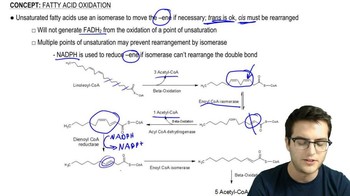
Fatty acids can be classified as saturated or unsaturated based on their chemical structure. Saturated fatty acids contain no double bonds between carbon atoms, making them solid at room temperature, while unsaturated fatty acids have one or more double bonds, resulting in a liquid state. This distinction is crucial for understanding the health implications of different types of fats.
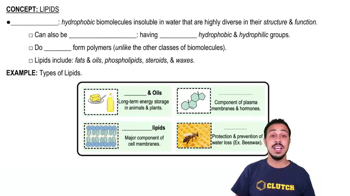
Lipids, including fats, play essential roles in biological systems, such as energy storage, cellular structure, and signaling. They are a key component of cell membranes, providing fluidity and integrity, and serve as a concentrated energy source, making them vital for metabolic processes.