Describe three ways that cancer cells differ from normal cells.
Guida verificata passo dopo passo
1
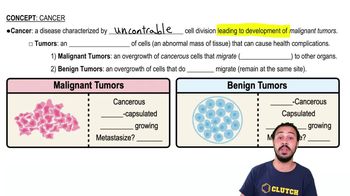
Cancer cells often exhibit uncontrolled growth and division, unlike normal cells which have regulated cell cycles and growth patterns.
Cancer cells can evade apoptosis, the programmed cell death that normal cells undergo when damaged or no longer needed.
Cancer cells have the ability to invade surrounding tissues and metastasize to distant sites in the body, whereas normal cells typically remain in their designated locations.
Risposta video verificata per un problema simile:
Questa soluzione video è stata consigliata dai nostri tutor come utile per risolvere questo problema.
Durata del video:
3m
Guarda un video:
0 Commenti
Concetti chiave
Ecco i concetti essenziali che devi comprendere per rispondere correttamente alla domanda.
Uncontrolled Proliferation
Cancer cells exhibit uncontrolled proliferation, meaning they can divide and grow indefinitely without the normal regulatory mechanisms that limit cell division in healthy cells. This is often due to mutations in genes that control the cell cycle, allowing cancer cells to bypass checkpoints that would typically prevent excessive growth.
Unlike normal cells, which adhere to their designated locations, cancer cells can invade surrounding tissues and spread to distant sites in the body through a process called metastasis. This ability to migrate and establish secondary tumors is a hallmark of cancer and contributes significantly to its severity and treatment challenges.
Cancer cells often exhibit altered metabolism, commonly referred to as the Warburg effect, where they preferentially utilize glycolysis for energy production even in the presence of oxygen. This metabolic shift supports rapid growth and proliferation, providing the necessary building blocks for cell division and survival in low-oxygen environments.

 3:05 minuti
 Guida verificata passo dopo passo
 03:22
03:22