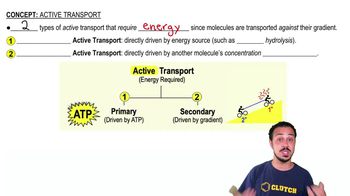
A substance moving across a membrane against a concentration gradient is moving by .
a. passive transport;
b. osmosis;
c. facilitated diffusion;
d. active transport;
e. diffusion
Guida verificata passo dopo passo
1
Identify the key concept: A substance moving against a concentration gradient.
Understand that moving against a concentration gradient requires energy input.
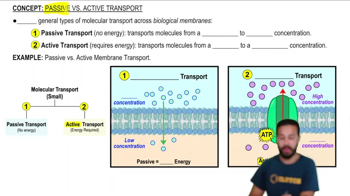
Recall that passive transport, osmosis, facilitated diffusion, and diffusion do not require energy.
Recognize that active transport is the process that requires energy to move substances against a concentration gradient.
Conclude that the correct answer involves a process that uses energy to move substances across a membrane.
Risposta video verificata per un problema simile:
Questa soluzione video è stata consigliata dai nostri tutor come utile per risolvere questo problema.
Durata del video:
47s
Guarda un video:
0 Commenti
Concetti chiave
Ecco i concetti essenziali che devi comprendere per rispondere correttamente alla domanda.
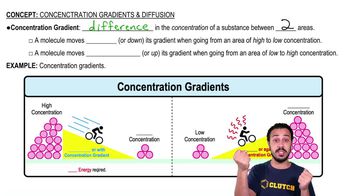
Concentration Gradient
A concentration gradient refers to the difference in the concentration of a substance across a space or membrane. Substances naturally move from areas of higher concentration to areas of lower concentration, a process that is fundamental to understanding transport mechanisms in cells.
Active transport is the process by which substances move across a cell membrane against their concentration gradient, requiring energy, typically in the form of ATP. This mechanism is crucial for maintaining cellular homeostasis and allowing cells to uptake necessary nutrients even when they are in lower concentrations outside the cell.
Passive transport is the movement of substances across a cell membrane without the use of energy, occurring along the concentration gradient. This includes processes like diffusion, osmosis, and facilitated diffusion, where molecules move from areas of higher concentration to lower concentration until equilibrium is reached.

 0:47 minuti
 Guida verificata passo dopo passo
 04:51
04:51