Skip to main content
Anatomy & Physiology
Il mio corso
Impara
Preparazione agli esami
AI Tutor
Guide di studio
Soluzioni per libri di testo
Flashcard
Esplora
Prova l'app
Il mio corso
Impara
Preparazione agli esami
AI Tutor
Guide di studio
Soluzioni per libri di testo
Flashcard
Esplora
Prova l'app
Indietro
Arteries quiz
Puoi toccare per girare la carta.
What is the primary function of arteries in the circulatory system?
Puoi toccare per girare la carta.
👆
What is the primary function of arteries in the circulatory system?
Arteries carry blood away from the heart to various parts of the body.
Avanzamenti del tracciato
I pulsanti di controllo sono stati cambiati in modalità "navigazione".
1/15
Flashcard correlate
Pratica correlata
Video consigliati
Arteries definitions
Arteries
15 Termini
Arteries
19. The Blood Vessels
6 Problemi
Argomento
Jason
Capillaries
19. The Blood Vessels
6 Problemi
Argomento
Jason
19. The Blood Vessels - Part 1 of 2
4 Argomenti
10 Problemi
Capitolo
Jason
19. The Blood Vessels - Part 2 of 2
4 Argomenti
9 Problemi
Capitolo
Bruce
VideoThumbView.guidedCourse
14:43
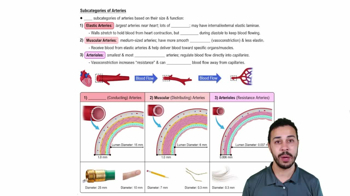
Subcategories of Arteries
5674
views
110
rank
1
comments
VideoThumbView.guidedCourse
1:39
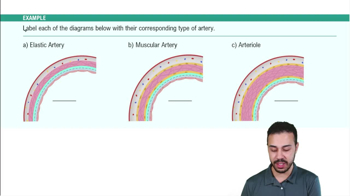
Arteries Example 2
4135
views
62
rank
VideoThumbView.guidedCourse
1:42
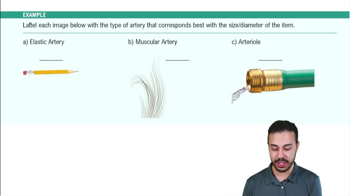
Arteries Example 1
4387
views
73
rank
Termini in questo insieme (15)
Nascondere definizioni
What is the primary function of arteries in the circulatory system?
Arteries carry blood away from the heart to various parts of the body.
Which layer of the artery wall is especially thick compared to veins, and what does it contain?
The tunica media is especially thick in arteries and contains smooth muscle.
How do the lumens of arteries compare to those of veins?
Arteries have smaller lumens compared to veins, which means veins can store a larger volume of blood.
Why do arteries have a high content of elastic fibers?
Elastic fibers allow arteries to expand and recoil to accommodate high pressure surges from the heart.
What are the three subcategories of arteries based on size and function?
The three subcategories are elastic arteries, muscular arteries, and arterioles.
What is another name for elastic arteries and why?
Elastic arteries are also called conducting arteries because they conduct blood from the heart to muscular arteries.
Where are elastic arteries located and what is their main structural feature?
Elastic arteries are located closest to the heart and have a large lumen diameter relative to their wall thickness.
What is the main function of muscular arteries?
Muscular arteries distribute blood to specific organs and muscles.
What proportion of a muscular artery's mass is made up of smooth muscle?
About 75% of a muscular artery's mass is smooth muscle.
What are arterioles and what is their primary role?
Arterioles are the smallest and most numerous arteries, and they regulate blood flow into capillaries.
Why are arterioles also called resistance arteries?
They are called resistance arteries because their vasoconstriction greatly impacts resistance to blood flow in the cardiovascular system.
How does the elasticity of elastic arteries benefit blood flow during the heart's relaxation period?
The recoil of elastic arteries helps keep blood flowing continuously even when the heart is relaxed.
How do the wall thickness and lumen diameter of elastic arteries compare?
Elastic arteries have a lumen diameter much greater than their wall thickness.
What is the size range of arterioles compared to household items?
Arterioles range from about the diameter of a hair (0.18 mm) down to microscopic sizes (15 micrometers).
How does vasoconstriction in arterioles affect blood flow?
Vasoconstriction in arterioles increases resistance and can redirect blood flow away from certain capillaries.
 IndietroIndietro

 14:43
14:43