Skip to main content
Anatomy & Physiology
Il mio corso
Impara
Preparazione agli esami
AI Tutor
Guide di studio
Soluzioni per libri di testo
Flashcard
Esplora
Prova l'app
Il mio corso
Impara
Preparazione agli esami
AI Tutor
Guide di studio
Soluzioni per libri di testo
Flashcard
Esplora
Prova l'app
Indietro
Classification of Joints quiz #3
Puoi toccare per girare la carta.
How many functional and structural joint classifications exist?
Puoi toccare per girare la carta.
👆
How many functional and structural joint classifications exist?
There are three functional joint classifications and three structural joint classifications.
Avanzamenti del tracciato
I pulsanti di controllo sono stati cambiati in modalità "navigazione".
1/15
Flashcard correlate
Pratica correlata
Video consigliati
Classification of Joints definitions
Classification of Joints
15 Termini
Classification of Joints quiz #1
Classification of Joints
40 Termini
Classification of Joints quiz #2
Classification of Joints
24 Termini
Classification of Joints
8. Joints
4 Problemi
Argomento
Bruce
Structural Class: Fibrous Joints
8. Joints
4 Problemi
Argomento
Bruce
8. Joints
6 Argomenti
14 Problemi
Capitolo
Bruce
VideoThumbView.guidedCourse
01:43
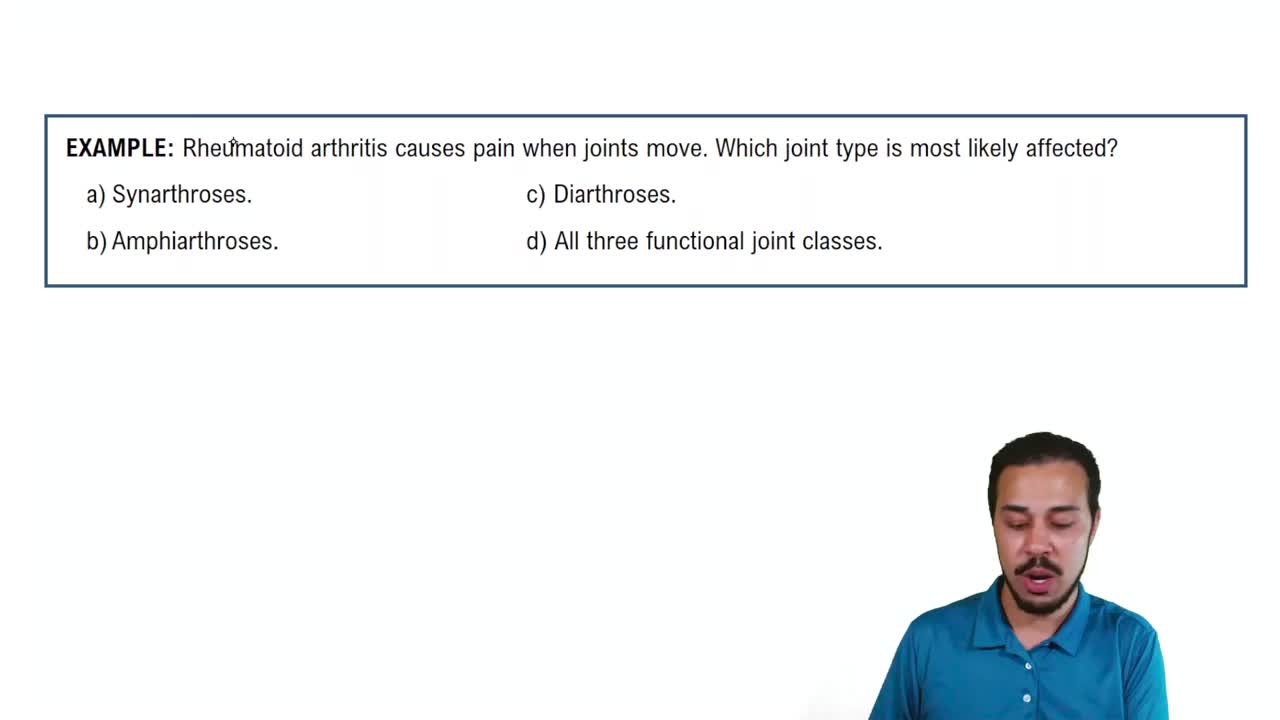
Classification of Joints Example 1
8507
views
178
rank
VideoThumbView.guidedCourse
01:33
Classification of Joints Example 2
7282
views
135
rank
VideoThumbView.guidedCourse
01:19
Introduction to Classification of Joints
11361
views
178
rank
1
comments
Termini in questo insieme (15)
Nascondere definizioni
How many functional and structural joint classifications exist?
There are three functional joint classifications and three structural joint classifications.
What is the basis for structural joint classification?
Structural joint classification is based on the type of material binding the bones together.
What is an amphiarthrosis joint, and how much movement does it allow?
An amphiarthrosis is a functional joint classification that allows a little or an average amount of movement.
What type of movement do synarthroses allow?
Synarthroses allow no movement; they are immovable joints.
What is an example of a synarthrosis joint?
An example of a synarthrosis joint is the suture between bones of the skull.
What is an example of an amphiarthrosis joint?
An example of an amphiarthrosis joint is the intervertebral disc joint in the spine.
What is an example of a diarthrosis joint?
An example of a diarthrosis joint is the shoulder joint.
What binds the bones together in fibrous joints?
Fibrous joints are bound together by collagen fibers of dense connective tissue.
What functional classifications can fibrous joints be?
Fibrous joints can be classified functionally as synarthroses or amphiarthroses.
What is the mobility and stability of cartilaginous joints?
Cartilaginous joints provide stability but allow only limited mobility.
What is a synovial joint, and what is its main structural feature?
A synovial joint is characterized by a synovial cavity between the bones, allowing for dynamic movement.
What is the main advantage of synovial joints?
Synovial joints allow for a wide range of dynamic and free movement.
Can a single joint be classified into both a functional and a structural category?
Yes, each joint is classified into one functional and one structural category, resulting in overlap between the two systems.
What is the role of the synovial cavity in synovial joints?
The synovial cavity allows for free movement and contains synovial fluid to lubricate the joint.
Which structural joint type is most likely to be immobile?
Fibrous joints are most likely to be immobile.
 IndietroIndietro
 01:43
01:43