Skip to main content
Anatomy & Physiology
Il mio corso
Impara
Preparazione agli esami
AI Tutor
Guide di studio
Soluzioni per libri di testo
Flashcard
Esplora
Prova l'app
Il mio corso
Impara
Preparazione agli esami
AI Tutor
Guide di studio
Soluzioni per libri di testo
Flashcard
Esplora
Prova l'app
Indietro
Fibrous Layer of the Eyeball definitions
Puoi toccare per girare la carta.
Fibrous Layer
Puoi toccare per girare la carta.
👆
Fibrous Layer
Outermost layer of the eye, composed of collagen, providing protection, shape, and muscle attachment.
Avanzamenti del tracciato
I pulsanti di controllo sono stati cambiati in modalità "navigazione".
1/15
Flashcard correlate
Pratica correlata
Video consigliati
Fibrous Layer of the Eyeball quiz
Fibrous Layer of the Eyeball
15 Termini
Fibrous Layer of the Eyeball
15. The Special Senses
2 Problemi
Argomento
Vascular Layer of the Eyeball
15. The Special Senses
1 problema
Argomento
15. The Special Senses
8 Argomenti
13 Problemi
Capitolo
Bruce
5:59
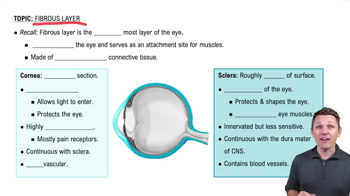
Fibrous Layer
5674
views
105
rank
2
comments
2:52
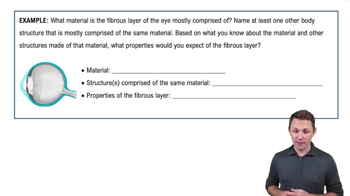
Fibrous Layer of the Eyeball Example 1
4307
views
79
rank
Termini in questo insieme (15)
Nascondere definizioni
Fibrous Layer
Outermost layer of the eye, composed of collagen, providing protection, shape, and muscle attachment.
Collagen
A strong, flexible protein fiber that forms the fibrous connective tissue of the eye's outer layer.
Cornea
Transparent front part of the fibrous layer, allowing light entry and highly sensitive to irritants.
Sclera
White part of the eye, making up 80% of its surface, providing protection, shape, and muscle attachment.
Innervation
The supply of nerves to the cornea, primarily pain receptors, making it highly sensitive.
Avascular
Characteristic of the cornea, indicating the absence of blood vessels to maintain transparency.
Dura Mater
Tough outer membrane of the CNS, continuous with the sclera, reflecting eye-brain connection.
Optic Nerve
Nerve that transmits visual information from the retina to the brain, surrounded by dura mater.
Blood Vessels
Present in the sclera, becoming visible when eyes are bloodshot, unlike the avascular cornea.
Pain Receptors
Nerve endings in the cornea that detect irritants, causing discomfort to protect the eye.
Eye Muscles
Muscles attached to the sclera, enabling eye movement by pulling the eyeball in various directions.
Central Nervous System
Comprises the brain and spinal cord, with developmental connections to the eye via the sclera.
Transverse Section
A top-down view of the eye, used to study the arrangement of its layers, including the fibrous layer.
Embryological Tissue
Origin of the cornea and sclera, developing from different tissues but forming a continuous layer.
Aqueous Humor
Fluid that helps maintain the eye's shape, inflating the fibrous layer like a soccer ball.
 IndietroIndietro
 5:59
5:59