Skip to main content
Anatomy & Physiology
Il mio corso
Impara
Preparazione agli esami
AI Tutor
Guide di studio
Soluzioni per libri di testo
Flashcard
Esplora
Prova l'app
Il mio corso
Impara
Preparazione agli esami
AI Tutor
Guide di studio
Soluzioni per libri di testo
Flashcard
Esplora
Prova l'app
Indietro
Introduction to Special Senses definitions
4 Gli studenti hanno trovato questo utile
Puoi toccare per girare la carta.
General senses
Puoi toccare per girare la carta.
👆
General senses
Senses distributed throughout the body, including temperature, pain, and pressure.
Avanzamenti del tracciato
I pulsanti di controllo sono stati cambiati in modalità "navigazione".
1/15
Flashcard correlate
Pratica correlata
Video consigliati
Introduction to Special Senses quiz #1
Introduction to Special Senses
39 Termini
Introduction to Special Senses quiz #2
Introduction to Special Senses
18 Termini
Introduction to Special Senses quiz #3
Introduction to Special Senses
10 Termini
Introduction to Special Senses
15. The Special Senses
5 Problemi
Argomento
Bruce
Structure of the Eyeball
15. The Special Senses
2 Problemi
Argomento
15. The Special Senses
8 Argomenti
13 Problemi
Capitolo
Bruce
5:05
Special Senses
9814
views
255
rank
2
comments
3:08
Introduction to Special Senses Example 1
6405
views
142
rank
Termini in questo insieme (15)
Nascondere definizioni
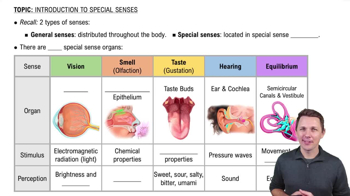
General senses
Senses distributed throughout the body, including temperature, pain, and pressure.
Special senses
Senses located in specific organs in the head, including vision, smell, taste, hearing, and equilibrium.
Vision
The sense that measures electromagnetic radiation, perceived as brightness and color.
Olfactory epithelium
Tissue in the nasal cavity responsible for detecting chemical properties perceived as odors.
Gustation
The sense of taste, detecting chemical properties of food as sweet, sour, salty, bitter, and umami.
Cochlea
A spiral-shaped organ in the ear that detects pressure waves, perceived as sound.
Equilibrium
The sense that measures movement and gravity, helping determine orientation and balance.
Electromagnetic radiation
Energy waves, including light, that are detected by the eyes for vision.
Olfactory bulb
A brain structure connected to the olfactory epithelium, processing smell information.
Taste buds
Sensory organs on the tongue that detect the five basic tastes.
Semicircular canals
Structures in the inner ear involved in detecting rotational movement for balance.
Vestibule
Part of the inner ear that helps sense linear movement and gravity for balance.
Brightness
The intensity of electromagnetic radiation perceived by the eyes.
Color
A perception based on the wavelength of light entering the eyes.
Pressure waves
Vibrations in the air detected by the ear, perceived as sound.
 IndietroIndietro
 5:05
5:05