Skip to main content
Anatomy & Physiology
Il mio corso
Impara
Preparazione agli esami
AI Tutor
Guide di studio
Soluzioni per libri di testo
Flashcard
Esplora
Prova l'app
Il mio corso
Impara
Preparazione agli esami
AI Tutor
Guide di studio
Soluzioni per libri di testo
Flashcard
Esplora
Prova l'app
Indietro
Law of Partial Pressure definitions
1 Lo studente ha trovato utile questo
Puoi toccare per girare la carta.
Respiration
Puoi toccare per girare la carta.
👆
Respiration
The process involving the movement of oxygen and carbon dioxide in and out of the blood driven by pressure gradients.
Avanzamenti del tracciato
I pulsanti di controllo sono stati cambiati in modalità "navigazione".
1/15
Flashcard correlate
Pratica correlata
Video consigliati
Law of Partial Pressure quiz #1
Law of Partial Pressure
10 Termini
Law of Partial Pressure
22. The Respiratory System
3 Problemi
Argomento
Jason
Respiration
22. The Respiratory System
5 Problemi
Argomento
22. The Respiratory System - Part 1 of 2
5 Argomenti
9 Problemi
Capitolo
Bruce
22. The Respiratory System - Part 2 of 2
1 Argomento
2 Problemi
Capitolo
6:12
Partial Pressure
4204
views
62
rank
5:51
Pressures: Dalton’s and Henry’s Laws
3938
views
66
rank
3:18
Law of Partial Pressure Example 1
3345
views
53
rank
Termini in questo insieme (15)
Nascondere definizioni
Respiration
The process involving the movement of oxygen and carbon dioxide in and out of the blood driven by pressure gradients.
Partial Pressure
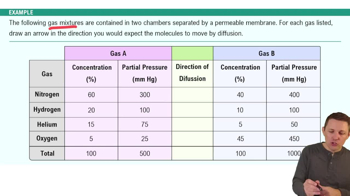
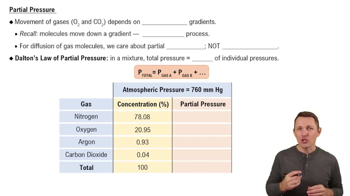
The pressure exerted by a single type of gas in a mixture of gases, crucial for understanding gas diffusion.
Dalton's Law
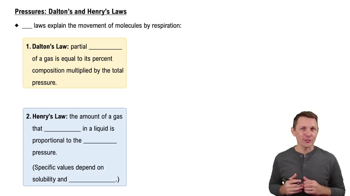
States that the total pressure of a gas mixture is the sum of the partial pressures of each individual gas.
Henry's Law
Indicates that the amount of gas dissolved in a liquid is proportional to its partial pressure.
Pressure Gradient
The difference in pressure that drives the passive movement of gases across membranes.
Atmospheric Pressure
The pressure exerted by the weight of the atmosphere, typically 760 mmHg at sea level.
Nitrogen
A major component of atmospheric air, making up about 78% of it, with a significant partial pressure.
Oxygen
A vital gas for respiration, constituting about 21% of atmospheric air, with a notable partial pressure.
Carbon Dioxide
A trace gas in the atmosphere, crucial for respiration, with a very low partial pressure.
Argon
An inert gas making up about 1% of the atmosphere, not significant in physiological processes.
Solubility
The ability of a gas to dissolve in a liquid, influenced by its partial pressure and other factors.
Sea Level
The reference point for atmospheric pressure, where it is typically 760 mmHg.
Altitude
The height above sea level, affecting atmospheric pressure and gas solubility.
Homeostasis
The body's ability to maintain a stable internal environment, including constant temperature.
Ventilation
The process of moving air in and out of the lungs, facilitating gas exchange.
 IndietroIndietro

 6:12
6:12