Skip to main content
Anatomy & Physiology
Il mio corso
Impara
Preparazione agli esami
AI Tutor
Guide di studio
Soluzioni per libri di testo
Flashcard
Esplora
Prova l'app
Il mio corso
Impara
Preparazione agli esami
AI Tutor
Guide di studio
Soluzioni per libri di testo
Flashcard
Esplora
Prova l'app
Indietro
Pressure in the Lungs and Pleural Cavity definitions
1 Lo studente ha trovato utile questo
Puoi toccare per girare la carta.
Lungs
Puoi toccare per girare la carta.
👆
Lungs
Elastic organs that change size with the thoracic cavity, naturally tending to collapse due to elasticity and surface tension.
Avanzamenti del tracciato
I pulsanti di controllo sono stati cambiati in modalità "navigazione".
1/15
Flashcard correlate
Pratica correlata
Video consigliati
Pressure in the Lungs and Pleural Cavity quiz
Pressure in the Lungs and Pleural Cavity
10 Termini
Pressure in the Lungs and Pleural Cavity quiz #1
Pressure in the Lungs and Pleural Cavity
11 Termini
Pressure in the Lungs and Pleural Cavity
22. The Respiratory System
4 Problemi
Argomento
Jason
Ventilation
22. The Respiratory System
1 problema
Argomento
22. The Respiratory System - Part 1 of 2
5 Argomenti
9 Problemi
Capitolo
Bruce
22. The Respiratory System - Part 2 of 2
1 Argomento
2 Problemi
Capitolo
4:01
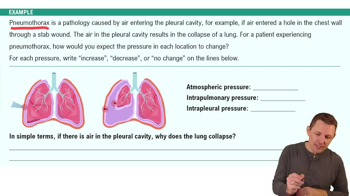
Pressure in the Lungs and Pleural Cavity Example 2
5203
views
90
rank
5:46
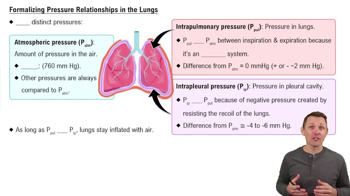
Formalizing Pressure Relationships in the Lungs
5980
views
119
rank
5:45
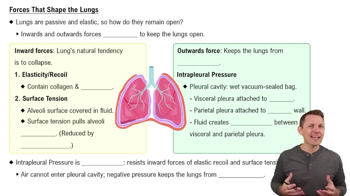
Forces That Shape the Lungs
8143
views
180
rank
1
comments
Termini in questo insieme (15)
Nascondere definizioni
Lungs
Elastic organs that change size with the thoracic cavity, naturally tending to collapse due to elasticity and surface tension.
Alveoli
Tiny air sacs in the lungs where gas exchange occurs, lined with fluid that creates surface tension.
Surfactant
Substance that reduces surface tension in the alveoli, preventing lung collapse.
Intrapleural Pressure
Negative pressure within the pleural cavity that prevents lung collapse by resisting elastic recoil.
Pleural Cavity
Space between the visceral and parietal pleura, containing fluid that creates adhesion.
Visceral Pleura
Membrane attached to the lung surface, part of the pleural cavity.
Parietal Pleura
Membrane attached to the chest wall, part of the pleural cavity.
Atmospheric Pressure
Pressure exerted by the weight of the atmosphere, typically 760 mmHg at sea level.
Intrapulmonary Pressure
Pressure within the lungs that equalizes with atmospheric pressure during breathing.
Elastic Recoil
Tendency of the lungs to return to their original size after being stretched.
Surface Tension
Cohesive force at the surface of a liquid, causing alveoli to tend to collapse.
Thoracic Cavity
Body cavity that houses the lungs and heart, changes size during breathing.
Collagen
Protein in connective tissue providing strength and structure to the lungs.
Elastin
Protein in the lungs that allows them to stretch and recoil like a rubber band.
Negative Pressure
Pressure lower than atmospheric, creating a suction effect in the pleural cavity.
 IndietroIndietro

 4:01
4:01