 Indietro
Chapter 24: Nutrition, Metabolism, and Energy Balance – Study Guide
Guida di studio - Note intelligenti
 Appunti personalizzati basati sui tuoi materiali, ampliati con definizioni chiave, esempi e contesto.
Nutrition, Metabolism, and Energy Balance
Introduction
This chapter explores the essential nutrients required for human health, the metabolic pathways that convert these nutrients into energy, and the mechanisms regulating energy balance and body temperature. Understanding these processes is fundamental for Anatomy & Physiology students, as they underpin cellular function, tissue maintenance, and overall homeostasis.
Part 1—Nutrients
Categories of Nutrients
Nutrients are substances in food necessary for growth, maintenance, and repair. They are classified into five categories:
Macronutrients: Carbohydrates, lipids, and proteins (required in large amounts)
Micronutrients: Vitamins and minerals (required in small amounts)
Water: Essential for life, makes up a significant portion of food volume
Essential nutrients must be obtained from the diet because the body cannot synthesize them in sufficient quantities.
Energy Value of Nutrients
Measured in kilocalories (kcal): 1 kcal raises the temperature of 1 kg of water by 1°C.
Carbohydrates and proteins: 4 kcal/g
Lipids: 9 kcal/g
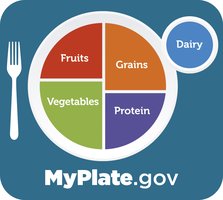
Dietary guidelines recommend balanced intake from fruits, vegetables, grains, protein, and dairy.
Carbohydrates
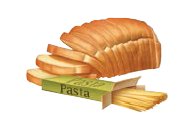
Carbohydrates are primarily derived from plants and serve as the main energy source for cells.
Sugars: Monosaccharides and disaccharides (fruits, honey, milk)
Starch: Polysaccharides (grains, vegetables)
Fiber: Insoluble (cellulose) aids digestion; soluble (pectin) lowers cholesterol
Uses: Glucose is used for ATP production; excess is stored as glycogen or fat
Dietary Requirement: 45–65% of total calories, mainly from complex carbohydrates
Lipids
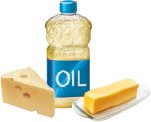
Lipids are a concentrated energy source and are essential for cell structure and function.
Types: Saturated, unsaturated, and trans fats; cholesterol
Essential Fatty Acids: Linoleic (omega-6) and linolenic (omega-3)
Uses: Energy storage, insulation, cell membrane structure, hormone synthesis
Dietary Requirement: 20–35% of total caloric intake; limit saturated fats
Proteins
Proteins are vital for structural and functional roles in the body.
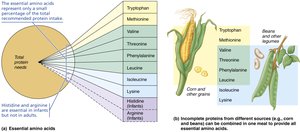
Complete Proteins: Animal products and soybeans (contain all essential amino acids)
Incomplete Proteins: Legumes, nuts, grains (lack one or more essential amino acids)
Uses: Structural (keratin, collagen), functional (enzymes, hormones)
Nitrogen Balance: Positive (growth, repair), negative (stress, malnutrition)
Dietary Requirement: 0.8 g/kg body weight per day
Vitamins and Minerals
Vitamins act as coenzymes, while minerals have structural and regulatory roles.
Water-soluble vitamins: B complex, C (not stored, excess excreted)
Fat-soluble vitamins: A, D, E, K (stored, excess can be toxic)
Antioxidants: Vitamins A, C, E, and selenium neutralize free radicals
Minerals: Calcium, phosphorus, potassium, sulfur, sodium, chlorine, magnesium
Roles: Bone strength, nerve function, oxygen transport, hormone synthesis
Part 2—Metabolism
Metabolic Pathways
Metabolism encompasses all biochemical reactions in the body, divided into:
Anabolism: Building larger molecules from smaller ones (e.g., protein synthesis)
Catabolism: Breaking down complex molecules into simpler ones (e.g., glycolysis)
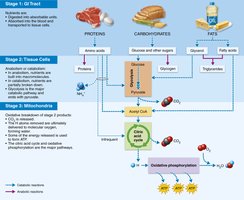
Three stages of nutrient processing:
Digestion and absorption
Anabolic and catabolic reactions in cells
Complete breakdown in mitochondria (producing ATP)
Oxidation-Reduction Reactions
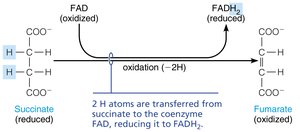
Cellular metabolism relies on redox reactions, where electrons are transferred between molecules.
Oxidation: Loss of electrons or hydrogen
Reduction: Gain of electrons or hydrogen
Coenzymes: NAD+ and FAD accept electrons during these reactions
ATP Synthesis
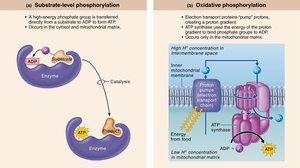
ATP is produced by two mechanisms:
Substrate-level phosphorylation: Direct transfer of phosphate to ADP
Oxidative phosphorylation: Electron transport chain and chemiosmosis in mitochondria
Carbohydrate Metabolism
Glycolysis
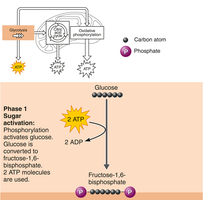
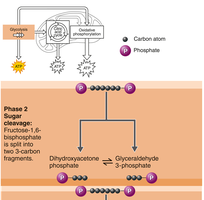
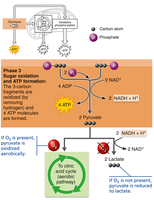
Glycolysis is the anaerobic breakdown of glucose in the cytosol, yielding pyruvate, ATP, and NADH.
Phase 1: Sugar activation – Glucose is phosphorylated twice
Phase 2: Sugar cleavage – Fructose-1,6-bisphosphate splits into two 3-carbon fragments
Phase 3: Sugar oxidation and ATP formation – Fragments are oxidized, ATP is produced
Citric Acid Cycle (Krebs Cycle)
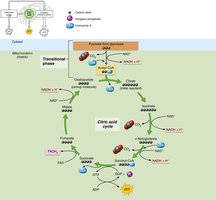
Occurs in the mitochondrial matrix, further oxidizing pyruvate to produce CO2, NADH, FADH2, and ATP.
Acetyl CoA enters the cycle, combining with oxaloacetate to form citrate
Cycle regenerates oxaloacetate and produces high-energy electron carriers
Oxidative Phosphorylation
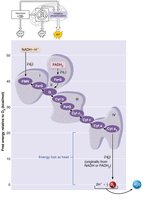
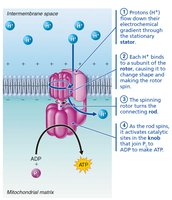
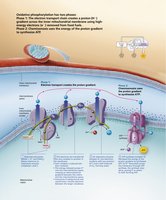
Electron transport chain uses oxygen to generate a proton gradient, driving ATP synthesis via ATP synthase.
Electrons from NADH and FADH2 are passed through protein complexes
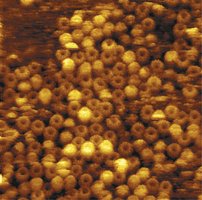
Proton gradient powers ATP synthase
Summary of ATP Production
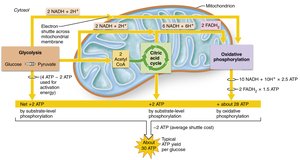
Complete oxidation of one glucose molecule yields approximately 30–32 ATP.
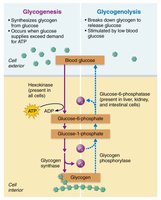
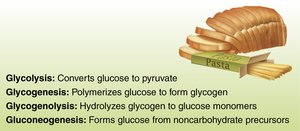
Glycogenesis, Glycogenolysis, and Gluconeogenesis
Glycogenesis: Formation of glycogen from glucose
Glycogenolysis: Breakdown of glycogen to release glucose
Gluconeogenesis: Formation of glucose from noncarbohydrate sources
Lipid Metabolism
Oxidation of Glycerol and Fatty Acids
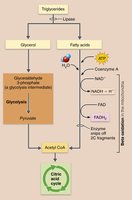
Triglycerides are broken down into glycerol and fatty acids, which are oxidized for energy.
Glycerol: Converted to glycolysis intermediate
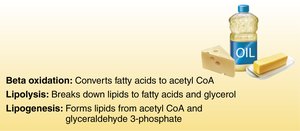
Fatty acids: Undergo beta oxidation to form acetyl CoA
Lipogenesis and Lipolysis
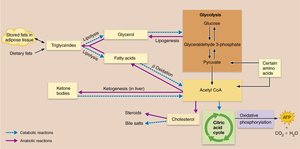
Lipogenesis: Synthesis of triglycerides from excess nutrients
Lipolysis: Breakdown of triglycerides into fatty acids and glycerol
Ketogenesis: Formation of ketone bodies from excess acetyl CoA
Amino Acid Metabolism
Degradation of Amino Acids
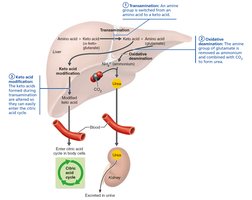
Amino acids are deaminated and converted to intermediates for energy production or gluconeogenesis.
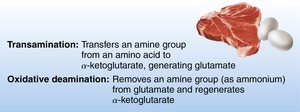
Transamination: Transfer of amine group to keto acid
Oxidative deamination: Removal of amine group as ammonium
Keto acid modification: Conversion to citric acid cycle intermediates
Protein Synthesis
Amino acids are used to build structural and functional proteins, regulated by hormones and requiring all essential amino acids.
Energy Balance and Metabolic States
Catabolic-Anabolic Balance
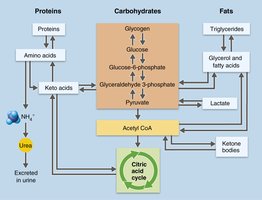
The body maintains a balance between breaking down and building up molecules, using nutrient pools for energy and biosynthesis.
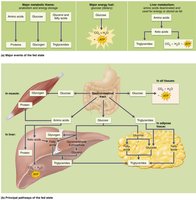
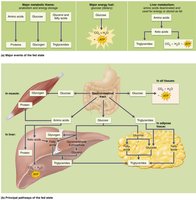
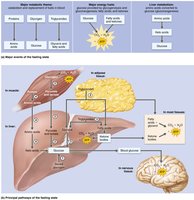
Fed State (Absorptive State)
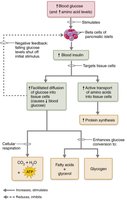
Occurs during and shortly after eating; anabolism exceeds catabolism, and nutrients are stored.
Glucose: Used for ATP, stored as glycogen or fat
Triglycerides: Stored in adipose tissue
Amino acids: Used for protein synthesis or converted to fat
Insulin: Main hormone directing these processes
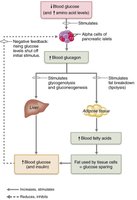
Fasting State (Postabsorptive State)
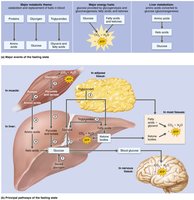
Occurs when the GI tract is empty; catabolism of stored nutrients maintains blood glucose.
Glycogenolysis: Releases glucose from liver and muscle
Lipolysis: Releases fatty acids and glycerol
Gluconeogenesis: Produces glucose from amino acids and glycerol
Glucagon: Main hormone stimulating these processes
Liver Functions and Cholesterol Metabolism
Liver Metabolic Functions
The liver metabolizes, stores, and detoxifies nutrients, regulates blood cholesterol, and synthesizes lipoproteins.
Cholesterol Transport and Regulation
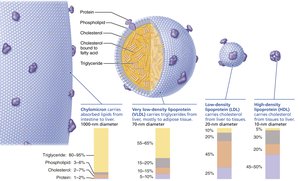
Lipoproteins: Transport cholesterol and triglycerides in blood
Types: VLDL, LDL, HDL, chylomicrons
Blood cholesterol: Levels and ratios are important for cardiovascular health
Diet and lifestyle: Affect cholesterol synthesis and excretion
Energy Balance and Body Temperature Regulation
Energy Balance
Energy intake must equal energy output to maintain stable body weight. Output includes heat, work, and storage.
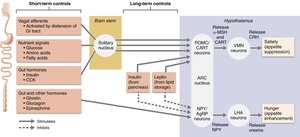
Regulation of Food Intake
Neural and hormonal signals regulate hunger and satiety, involving hypothalamic centers and hormones like leptin, insulin, ghrelin, and CCK.
Basal Metabolic Rate (BMR) and Total Metabolic Rate (TMR)
BMR: Energy needed for essential activities at rest
TMR: Total energy expenditure, increases with activity and food intake
Body Temperature Regulation
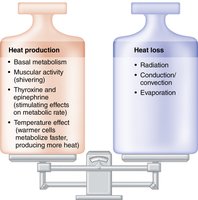
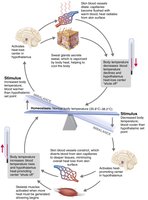
Body temperature is maintained by balancing heat production and loss, regulated by the hypothalamus.
Heat production: Basal metabolism, muscular activity, hormones
Heat loss: Radiation, conduction, convection, evaporation
Clinical Aspects and Developmental Considerations
Metabolic Disorders
Diabetes mellitus: Insulin deficiency or resistance
Phenylketonuria (PKU): Inability to metabolize phenylalanine
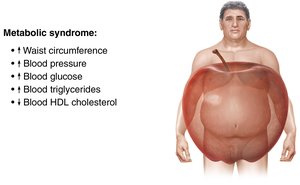
Metabolic syndrome: Cluster of risk factors for cardiovascular disease and diabetes
Developmental Aspects
Nutrition and metabolism change throughout life, affecting growth, maintenance, and aging. Adequate nutrition is critical during fetal development and early childhood, while metabolic rate declines with age.
Summary Table: Macronutrients
Nutrient | Sources | Main Functions | Energy Value |
|---|---|---|---|
Carbohydrates | Grains, vegetables, fruits | ATP production, storage as glycogen | 4 kcal/g |
Lipids | Oils, butter, meats | Energy storage, cell membranes, hormones | 9 kcal/g |
Proteins | Meat, eggs, legumes | Structural, functional molecules | 4 kcal/g |
Key Equations
ATP yield from glucose:
BMI calculation:
Additional info: Academic context was added to clarify metabolic pathways, clinical relevance, and regulatory mechanisms. Tables and images were included only when directly relevant to the explanation.
