
Ch. 1 Introduction to Anatomy and Physiology
Amerman- Human Anatomy & Physiology 3e
Amerman3rd EditionHuman Anatomy & PhysiologyISBN: 9780138247201, 9780138247928, 9780138201814Non è quello che usi tu?Cambia libro di testo
Capitolo 1, Problema 8

Which of the following best describes the position of a tissue in the levels of organization of the human body?
a. Tissues are the most fundamental level of organization.
b. Tissues are between cells and organs in the levels of organization.
c. Tissues are the most complex level of organization.
d. Tissues are between organs and systems in the levels of organization.

Guida verificata passo dopo passo
1
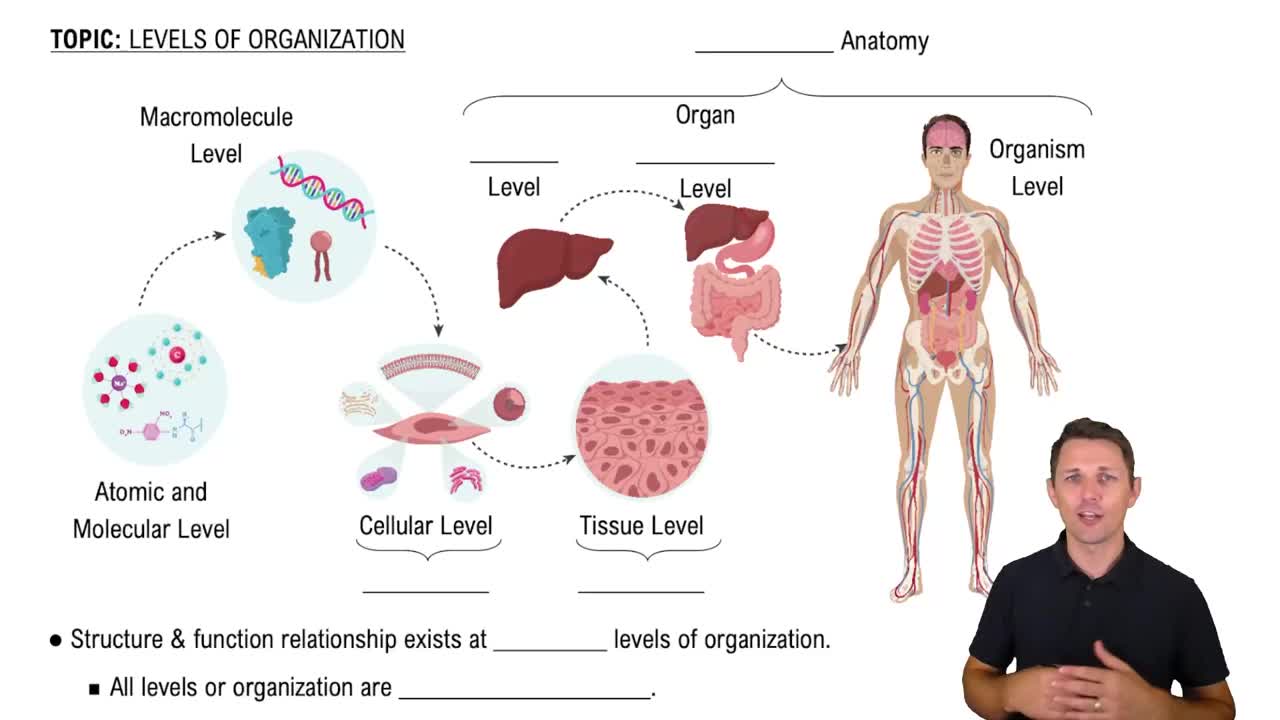
Understand the levels of organization in the human body: The human body is organized into hierarchical levels, starting from the simplest to the most complex. These levels are: cells, tissues, organs, organ systems, and the organism itself.
Define what tissues are: Tissues are groups of similar cells that work together to perform a specific function. Examples include epithelial tissue, connective tissue, muscle tissue, and nervous tissue.
Identify the position of tissues in the hierarchy: Tissues are formed by the organization of cells, and they combine to form organs. Therefore, tissues are positioned between cells and organs in the levels of organization.
Eliminate incorrect options: Option a is incorrect because cells, not tissues, are the most fundamental level of organization. Option c is incorrect because tissues are not the most complex level; the organism is. Option d is incorrect because tissues are not between organs and systems; they are between cells and organs.
Select the correct answer: Based on the hierarchy, the correct description is that tissues are between cells and organs in the levels of organization.

Risposta video verificata per un problema simile:

Questa soluzione video è stata consigliata dai nostri tutor come utile per risolvere questo problema.

Concetti chiave

Ecco i concetti essenziali che devi comprendere per rispondere correttamente alla domanda.

Levels of Organization

The levels of organization in the human body refer to the hierarchical structure that ranges from the simplest to the most complex. It typically includes cells, tissues, organs, and systems. Understanding this hierarchy is crucial for identifying where tissues fit within the broader context of biological organization.
Video consigliato:
05:04
The Levels of Organization

Tissues

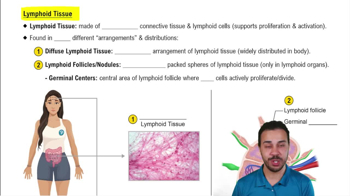
Tissues are groups of similar cells that work together to perform a specific function. In the human body, there are four primary types of tissues: epithelial, connective, muscle, and nervous. Recognizing the role of tissues helps clarify their position between cells and organs in the organizational structure.
Video consigliato:
Percorso guidato
4:55
Lymphoid Tissue

Organs and Systems

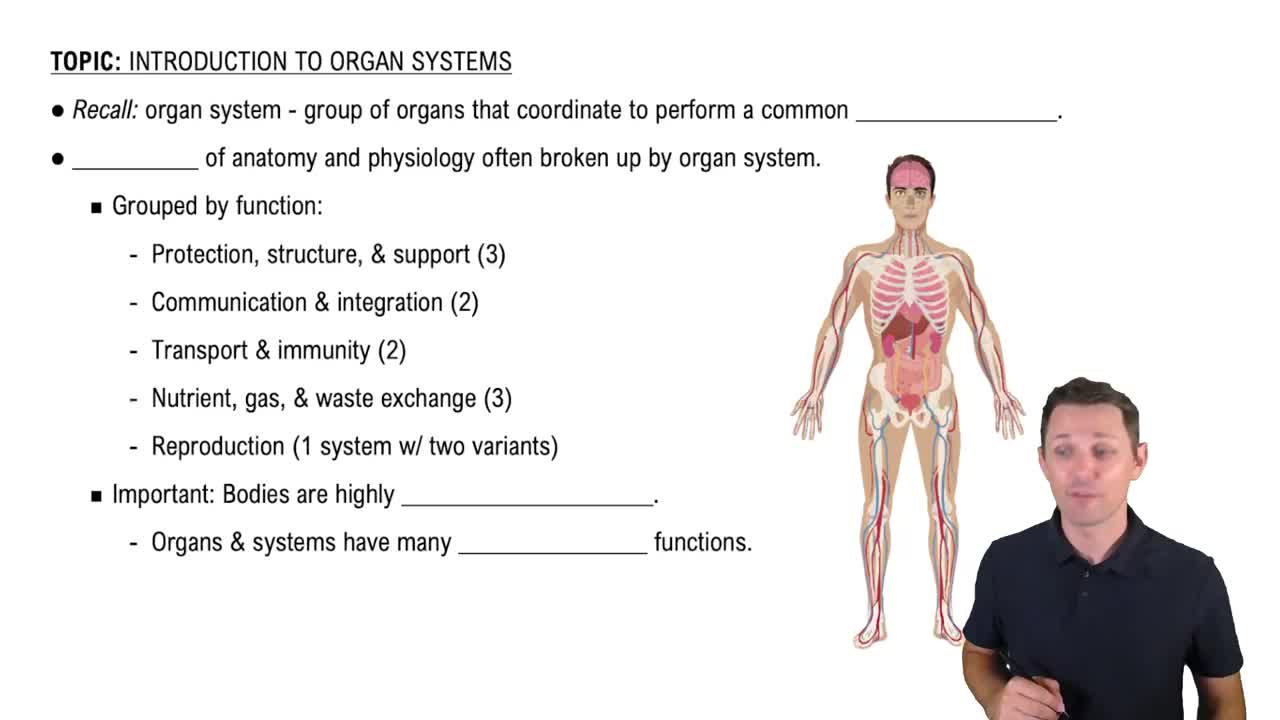
Organs are structures composed of different types of tissues that work together to perform specific functions, while systems are groups of organs that collaborate to carry out complex processes. Understanding the relationship between tissues, organs, and systems is essential for accurately determining the position of tissues in the levels of organization.
Video consigliato:
02:29
Introduction to Organ Systems
Pratica correlata
Domanda del libro di testo

Mark the following statements as true or false. If a statement is false, correct it to make a true statement.

The anatomical position features the person facing forward, feet shoulder-width apart, and palms facing posteriorly.

688
views
Domanda del libro di testo

Match the following terms with the correct definition.

Anterior: -----------a. Toward the back

Lateral: ------------b. Closer to the midline      

Proximal: ----------c. Farther away from the point of origin      

Posterior:----------d. Toward the front    

Inferior:------------e. Closer to the point of origin

Distal:------------- f. Toward the head

Medial: -----------g. Away from the body's midline

Superior:----------- h. Toward the tail 

903
views
Domanda del libro di testo

The arm is known as the_______region; the neck is known as the _______ region.

a. Otic; axillary

b. Antebrachial; dorsal

c. Brachial; cervical

d. Sural; crural

604
views
1
rank
Domanda del libro di testo

A parasagittal section divides the body or body part into:

a. Equal right and left parts

b. Front and back parts

c. Superior/proximal and inferior/distal parts

d. Unequal right and left parts

1364
views
Domanda del libro di testo

The upper and lower limbs are known broadly as the________ region.

a. Appendicular

b. Axial

c. Crural

d. Dorsal

755
views
Domanda del libro di testo

Mark the following statements as true or false. If a statement is false, correct it to make a true statement.

Living organisms react to changes in their environment known as stimuli.

772
views