Ch. 9 The Muscular System
Amerman- Human Anatomy & Physiology 3e
Amerman3rd EditionHuman Anatomy & PhysiologyISBN: 9780138247201, 9780138247928, 9780138201814Non è quello che usi tu?Cambia libro di testo
Capitolo 9, Problema 8

The thick, bandlike muscle of mastication that covers much of the ramus of the mandible is the:
a. masseter muscle.
b. temporalis muscle.
c. lateral pterygoid muscle.
d. risorius muscle.

Guida verificata passo dopo passo
1
Step 1: Understand the context of the question. The problem is asking about a muscle involved in mastication (chewing) that is thick and bandlike, and covers much of the ramus of the mandible. Mastication muscles are responsible for moving the jaw during chewing.
Step 2: Recall the anatomy of the mandible and the muscles of mastication. The ramus is the vertical portion of the mandible, and muscles of mastication include the masseter, temporalis, medial pterygoid, and lateral pterygoid.
Step 3: Analyze the descriptions of the muscles provided in the answer choices: - The masseter muscle is a thick, rectangular muscle that covers much of the ramus of the mandible and is one of the primary muscles of mastication. - The temporalis muscle is a fan-shaped muscle located on the side of the skull, primarily involved in elevating the mandible. - The lateral pterygoid muscle is smaller and located deeper, involved in side-to-side movements of the jaw. - The risorius muscle is not involved in mastication; it is a facial muscle responsible for pulling the corners of the mouth laterally.
Step 4: Match the description in the question to the correct muscle. The thick, bandlike muscle that covers much of the ramus of the mandible aligns with the masseter muscle, based on its anatomical location and function.
Step 5: Confirm your understanding by reviewing the role of the masseter muscle in mastication. It is one of the strongest muscles in the body and plays a key role in elevating the mandible to close the jaw during chewing.

Risposta video verificata per un problema simile:

Questa soluzione video è stata consigliata dai nostri tutor come utile per risolvere questo problema.

Concetti chiave

Ecco i concetti essenziali che devi comprendere per rispondere correttamente alla domanda.

Masseter Muscle

The masseter muscle is a thick, rectangular muscle located at the back of the jaw. It plays a crucial role in the process of mastication, or chewing, by elevating the mandible to close the mouth. This muscle is one of the primary muscles involved in biting and grinding food, making it essential for effective digestion.
Video consigliato:
2:00
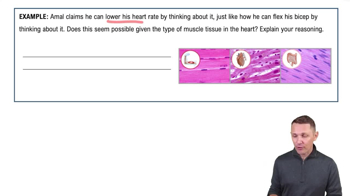
Introduction to Muscles and Muscle Tissue Example 1

Temporalis Muscle

The temporalis muscle is a fan-shaped muscle located on the side of the head, above the ear. It assists in elevating and retracting the mandible, contributing to the chewing process. While it is important for mastication, it is not as prominent as the masseter in covering the ramus of the mandible.
Video consigliato:
2:00
Introduction to Muscles and Muscle Tissue Example 1

Pterygoid Muscles

The pterygoid muscles, including the lateral and medial pterygoids, are located deeper in the jaw and are involved in the complex movements of the mandible. The lateral pterygoid muscle helps in depressing and protracting the mandible, while the medial pterygoid assists in elevating it. Together, they facilitate side-to-side movements necessary for grinding food.
Video consigliato:
2:00
Introduction to Muscles and Muscle Tissue Example 1
Pratica correlata
Domanda del libro di testo

Which of the erector spinae muscles is most lateral to the vertebral column?

a. Spinalis muscle

b. Iliocostalis muscle

c. Semispinalis muscle

d. Longissimus muscle

995
views
Domanda del libro di testo

Which of the following muscle groups is considered muscles of inspiration?

a. External intercostal muscles

b. Internal intercostal muscles

c. External oblique muscles

d. Internal oblique muscles

855
views
Domanda del libro di testo

Match the muscle with its main action:

_____Sternocleidomastoid muscle     

_____Transversus abdominis muscle     

_____Internal oblique muscle     

_____Rectus abdominis muscle     

_____Splenius capitis muscle     

_____Quadratus lumborum muscle.

a. Laterally flexes the trunk

b. Flexes the trunk

c. Compresses the abdominal cavity

d. Extends the vertebral column

e. Flexes the head

f. Extends the head

712
views
Domanda del libro di testo

Which eye muscle passes through the trochlea and turns the eye inferiorly and laterally?

a. Lateral rectus muscle

b. Inferior rectus muscle

c. Inferior oblique muscle

d. Superior oblique muscle

1021
views
Domanda del libro di testo

Mark the following statements as true or false. If the statement is false, correct it to make a true statement.

The buccinator muscle pulls the cheeks in, producing sucking movements.

852
views
Domanda del libro di testo

Mark the following statements as true or false. If the statement is false, correct it to make a true statement.

The temporalis and occipitalis muscles are attached to each other by the epicranial aponeurosis.

1014
views