During a neurobiology lecture, a professor repeatedly refers to group A and group B fibers, absolute refractory period, and myelin sheath gaps. Define these terms.
Ch. 11 Fundamentals of the Nervous System and Nervous Tissue
Hoehn, Haynes, Abbott12th EditionMarieb Human Anatomy & PhysiologyISBN: 9780138242732Non è quello che usi tu?Cambia libro di testo
Tutti i libri di testo
Hoehn, Haynes, Abbott 12th Edition
Ch. 11 Fundamentals of the Nervous System and Nervous Tissue
Problema 14
Hoehn, Haynes, Abbott 12th Edition
Ch. 11 Fundamentals of the Nervous System and Nervous Tissue
Problema 14Capitolo 11, Problema 14
Briefly describe the three stages of neuron development.
Guida verificata passo dopo passo1
Step 1: Understand that neuron development occurs in three main stages: proliferation, migration, and differentiation.
Step 2: Proliferation is the first stage where neural stem cells divide rapidly to produce a large number of neurons and glial cells. This process mainly happens in the ventricular zone of the developing neural tube.
Step 3: Migration is the second stage where newly formed neurons move from their birthplace to their final position in the brain or spinal cord. This movement is guided by chemical signals and structural pathways.
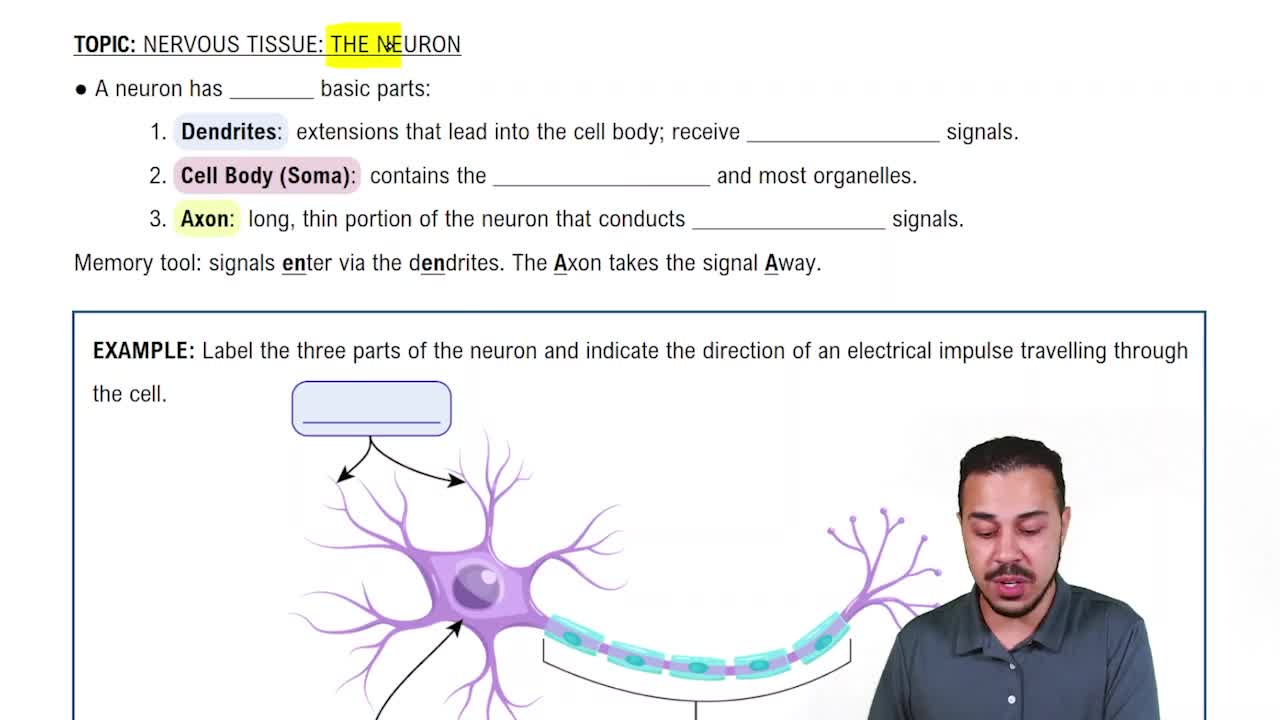
Step 4: Differentiation is the third stage where neurons develop their specific characteristics, such as forming axons and dendrites, establishing synaptic connections, and acquiring functional properties necessary for communication.
Step 5: Recognize that these stages are crucial for proper nervous system formation and function, and disruptions in any stage can lead to developmental disorders.
Concetti chiave
Ecco i concetti essenziali che devi comprendere per rispondere correttamente alla domanda.
Neurogenesis
Neurogenesis is the first stage of neuron development where neural stem cells divide and produce new neurons. This process occurs primarily during embryonic development and establishes the initial population of neurons in the nervous system.
Neuronal Migration
Neuronal migration is the movement of newly formed neurons from their birthplace to their final position in the brain. This stage is crucial for proper brain organization and the formation of functional neural circuits.
Video consigliato:
The Neuron
Neuronal Differentiation and Maturation
In this stage, neurons develop their specific structures such as axons and dendrites, and form synaptic connections. Differentiation allows neurons to acquire specialized functions, while maturation ensures they become fully functional within neural networks.
Video consigliato:
Percorso guidato
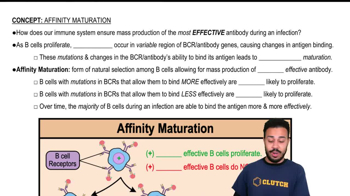
Affinity Maturation
Pratica correlata
Domanda del libro di testo
632
views
1
rank
Domanda del libro di testo
The velocity of nerve impulse conduction is greatest in
a. Heavily myelinated, large-diameter fibers
b. Myelinated, small-diameter fibers
c. Nonmyelinated, small-diameter fibers
d. Nonmyelinated, large-diameter fibers
964
views
Domanda del libro di testo
a. Describe the composition and function of the cell body.
b. How are axons and dendrites alike? In what ways (structurally and functionally) do they differ?
834
views
Domanda del libro di testo
a. What is myelin?
b. How does the myelination process differ in the CNS and PNS?
845
views
Domanda del libro di testo
a. Contrast unipolar, bipolar, and multipolar neurons structurally.
b. Indicate where each is most likely to be found.
1149
views
Domanda del libro di testo
Since all APs generated by a given nerve fiber have the same magnitude, how does the CNS 'know' whether a stimulus is strong or weak?
988
views