
Ch. 11 Fundamentals of the Nervous System and Nervous Tissue
Hoehn - Marieb Human Anatomy & Physiology, 12th edition
Hoehn, Haynes, Abbott12th EditionMarieb Human Anatomy & PhysiologyISBN: 9780138242732Non è quello che usi tu?Cambia libro di testo
Capitolo 11, Problema 19

Describe the events that must occur to generate an AP. Relate the sequence of changes in permeability to changes in the ion channels, and explain why the AP is an all-or-none phenomenon.

Guida verificata passo dopo passo
1
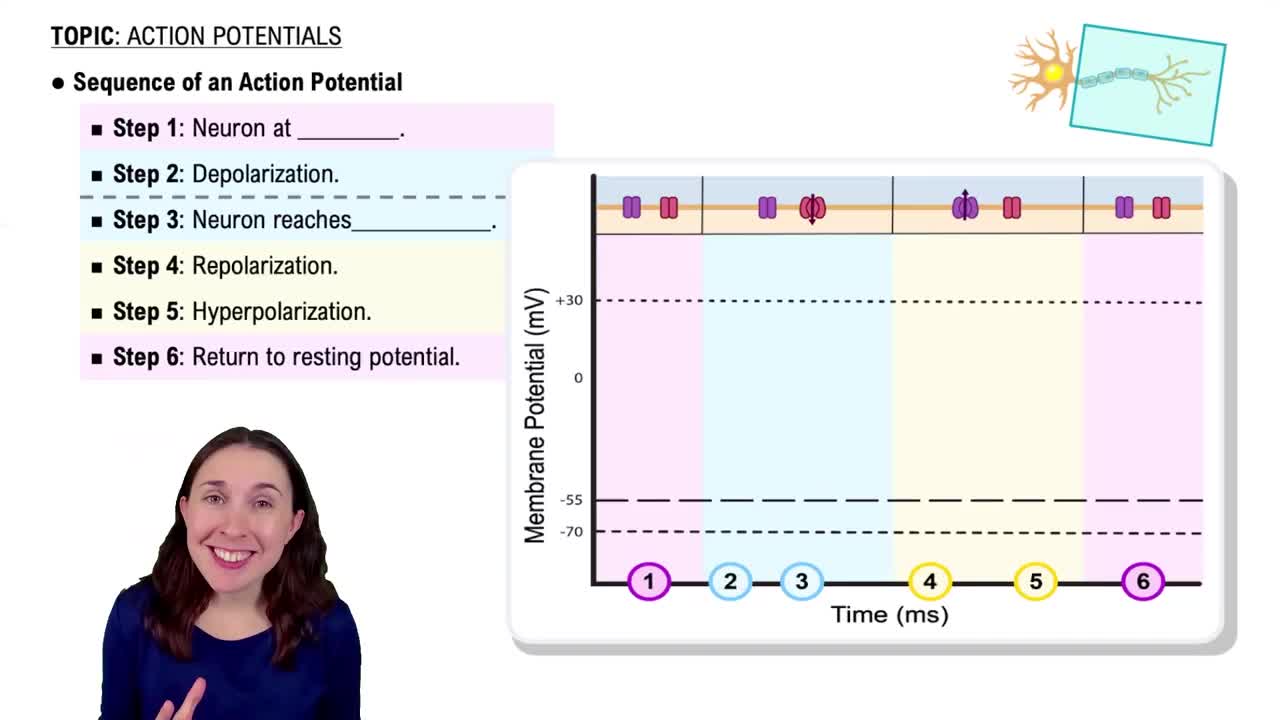
Begin by explaining that an action potential (AP) is generated when a neuron or muscle cell membrane depolarizes to a threshold level, triggering a rapid change in membrane potential.
Describe the initial event: voltage-gated sodium (Na\(\textsuperscript{+}\)) channels open in response to reaching threshold, increasing Na\(\textsuperscript{+}\) permeability and causing Na\(\textsuperscript{+}\) ions to flow into the cell, which depolarizes the membrane further.
Explain that shortly after, voltage-gated potassium (K\(\textsuperscript{+}\)) channels open, increasing K\(\textsuperscript{+}\) permeability and allowing K\(\textsuperscript{+}\) ions to exit the cell, which repolarizes and eventually hyperpolarizes the membrane.
Discuss how the sequential opening and closing of these ion channels (Na\(\textsuperscript{+}\) channels opening then inactivating, followed by K\(\textsuperscript{+}\) channels opening and closing) restore the resting membrane potential.
Clarify that the AP is an all-or-none phenomenon because once the threshold is reached, the positive feedback loop of Na\(\textsuperscript{+}\) channel opening ensures a full AP; if threshold is not reached, no AP occurs, making the response binary rather than graded.

Risposta video verificata per un problema simile:

Questa soluzione video è stata consigliata dai nostri tutor come utile per risolvere questo problema.
Durata del video:
2m

Concetti chiave

Ecco i concetti essenziali che devi comprendere per rispondere correttamente alla domanda.

Generation of an Action Potential

An action potential (AP) is initiated when a neuron’s membrane potential reaches a threshold, causing voltage-gated sodium channels to open. This leads to rapid sodium influx, depolarizing the membrane. Subsequently, potassium channels open to repolarize the membrane, restoring the resting potential.
Video consigliato:
03:53
Action Potential

Ion Channel Permeability Changes

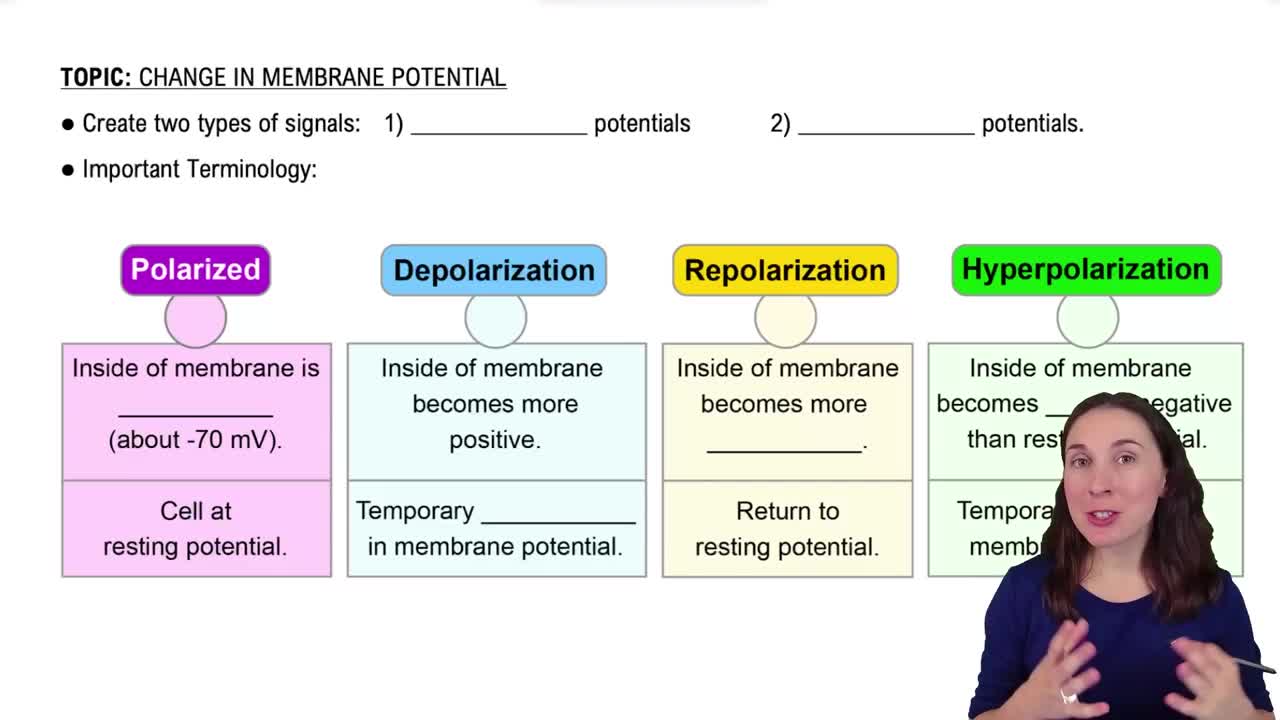
During an AP, permeability changes occur as voltage-gated sodium channels open first, increasing Na+ permeability and causing depolarization. Then, these channels inactivate while voltage-gated potassium channels open, increasing K+ permeability to repolarize and hyperpolarize the membrane.
Video consigliato:
03:31
Change in Membrane Potential

All-or-None Principle of Action Potentials

The all-or-none principle means an AP either occurs fully or not at all. If the threshold is reached, enough sodium channels open to trigger a full AP. If not, no AP occurs. This ensures consistent signal strength regardless of stimulus intensity above threshold.
Video consigliato:
03:53
Action Potential