Ch. 2 Chemistry Comes Alive
Hoehn - Marieb Human Anatomy & Physiology, 12th edition
Hoehn, Haynes, Abbott12th EditionMarieb Human Anatomy & PhysiologyISBN: 9780138242732Non è quello che usi tu?Cambia libro di testo
Capitolo 2, Problema 4

Which of the following does not describe a mixture?
a. Properties of its components are retained
b. Chemical bonds are formed
c. Components can be separated physically
d. Includes both heterogeneous and homogeneous examples

Guida verificata passo dopo passo
1
Step 1: Understand the question is asking to identify which element is NOT one of the four major elements that contribute most to the human body's mass.
Step 2: Recall the four major elements that make up the majority of the human body mass. These are Hydrogen (H), Carbon (C), Nitrogen (N), and Oxygen (O).
Step 3: Review the options given: Hydrogen, Carbon, Nitrogen, Sodium, and Oxygen.
Step 4: Compare each option to the list of the four major elements. Hydrogen, Carbon, Nitrogen, and Oxygen are all part of the major elements.
Step 5: Identify Sodium as the element that does not belong to the four major elements contributing to body mass, as it is a minor element present in smaller amounts.

Risposta video verificata per un problema simile:

Questa soluzione video è stata consigliata dai nostri tutor come utile per risolvere questo problema.
Durata del video:
2m

Concetti chiave

Ecco i concetti essenziali che devi comprendere per rispondere correttamente alla domanda.

Four Major Elements of Body Mass

The human body is primarily composed of four major elements: oxygen, carbon, hydrogen, and nitrogen. These elements make up the bulk of organic molecules such as proteins, lipids, carbohydrates, and nucleic acids, which are essential for life.
Video consigliato:
Percorso guidato
7:17
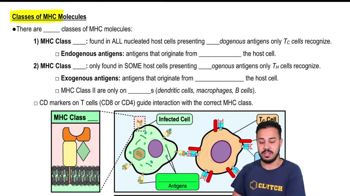
Classes of MHC Molecules

Role of Trace Elements

Trace elements like sodium, potassium, and calcium are present in smaller amounts but are vital for physiological functions such as nerve transmission and muscle contraction. However, they do not contribute significantly to overall body mass.
Video consigliato:
Percorso guidato
03:36
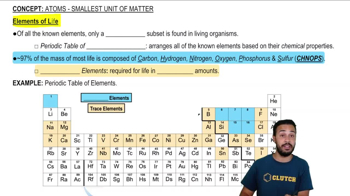
Elements of Life

Distinguishing Major vs. Minor Elements

Understanding the difference between major elements that constitute most of the body's mass and minor or trace elements that support specific functions is key. This distinction helps identify which elements are fundamental to body composition.
Video consigliato:
Percorso guidato
2:31
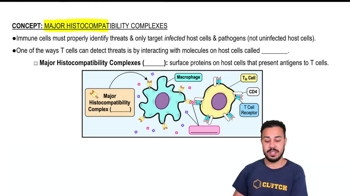
Major Histocompatibility Complexes