Ch. 28 Pregnancy and Human Development

Hoehn, Haynes, Abbott12th EditionMarieb Human Anatomy & PhysiologyISBN: 9780138242732
Non è quello che usi tu?Cambia libro di testoScegli un libro di testo diverso
TOC.tableOfContents
- Ch. 1 The Human Body: An Orientation25
- Ch. 2 Chemistry Comes Alive24
- Ch. 3 Cells: The Living Units24
- Ch. 4 Tissue: The Living Fabric19
- Ch. 5 The Integumentary System12
- Ch. 6 Bones and Skeletal Tissues19
- Ch. 7 The Skeleton14
- Ch. 8 Joints7
- Ch. 9 Muscles and Muscle Tissue26
- Ch. 10 The Muscular System25
- Ch. 11 Fundamentals of the Nervous System and Nervous Tissue23
- Ch. 12 The Central Nervous System25
- Ch. 13 The Peripheral Nervous System and Reflex Activity30
- Ch. 14 The Autonomic Nervous System16
- Ch. 15 The Special Senses26
- Ch. 16 The Endocrine System26
- Ch. 17 Blood27
- Ch. 18 The Cardiovascular System: The Heart25
- Ch. 19 The Cardiovascular System: Blood Vessels27
- Ch. 20 The Lymphatic System and Lymphoid Organs and Tissues16
- Ch. 21 The Immune System: Innate and Adaptive Body Defenses27
- Ch. 22 The Respiratory System21
- Ch. 23 The Digestive System31
- Ch. 24 Nutrition, Metabolism, and Energy Balance26
- Ch. 25 The Urinary System26
- Ch. 26 Fluid, Electrolyte, and Acid-Base Balance24
- Ch. 27 The Reproductive System24
- Ch. 28 Pregnancy and Human Development25
- Ch. 29 Heredity11
Hoehn, Haynes, Abbott12th EditionMarieb Human Anatomy & PhysiologyISBN: 9780138242732Non è quello che usi tu?Cambia libro di testo
Tutti i libri di testo Hoehn, Haynes, Abbott 12th EditionCh. 28 Pregnancy and Human DevelopmentProblema 1
Hoehn, Haynes, Abbott 12th EditionCh. 28 Pregnancy and Human DevelopmentProblema 1Capitolo 28, Problema 1
Indicate whether each of the following statements is describing (a) cleavage or (b) gastrulation.
_______ (1) period during which a morula forms
_______ (2) period when vast amounts of cell migration occur
_______ (3) period when the three embryonic germ layers appear
_______ (4) period during which the blastocyst is formed
 Guida verificata passo dopo passo
1
Step 1: Understand the definitions of the two processes: Cleavage is the early embryonic stage characterized by rapid cell division without growth, leading to the formation of a morula and then a blastocyst. Gastrulation is a later stage involving extensive cell migration and the formation of the three primary germ layers (ectoderm, mesoderm, and endoderm).
Step 2: Identify which process corresponds to the formation of a morula. Since the morula is a solid ball of cells formed by cleavage divisions, this period is part of cleavage.
Step 3: Determine which process involves vast amounts of cell migration. Gastrulation is known for significant cell movements as cells migrate to form distinct layers, so this period corresponds to gastrulation.
Step 4: Recognize when the three embryonic germ layers appear. The formation of these layers is the hallmark of gastrulation, so this period is gastrulation.
Step 5: Identify the period during which the blastocyst is formed. The blastocyst forms after the morula during cleavage, so this period is part of cleavage.
Concetti chiave
Ecco i concetti essenziali che devi comprendere per rispondere correttamente alla domanda.
Cleavage
Cleavage is the early embryonic stage characterized by rapid mitotic cell divisions without growth, transforming the zygote into a multicellular structure called the morula. This process increases cell number while maintaining the original embryo size, setting the stage for later development.
Video consigliato:

 3:03
3:03
Cleavage: Days 2-3
Gastrulation
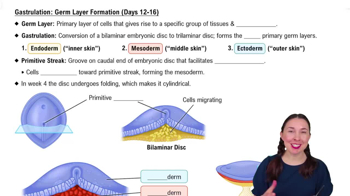
Gastrulation is a critical phase in embryonic development involving extensive cell migration and reorganization, leading to the formation of the three primary germ layers: ectoderm, mesoderm, and endoderm. These layers give rise to all tissues and organs in the organism.
Video consigliato:
 3:54
3:54Gastrulation: Germ Layer Formation (Days 12-16)
Blastocyst Formation
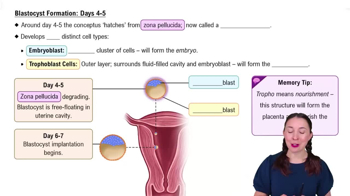
Blastocyst formation occurs after cleavage, when the embryo develops a fluid-filled cavity called the blastocoel, differentiating into an outer trophoblast and an inner cell mass. This structure is essential for implantation and subsequent embryonic development.
Video consigliato:
 2:18
2:18Blastocyst Formation: Days 4-5
Pratica correlata