Ch. 28 Pregnancy and Human Development
Hoehn, Haynes, Abbott12th EditionMarieb Human Anatomy & PhysiologyISBN: 9780138242732
Non è quello che usi tu?Cambia libro di testoScegli un libro di testo diverso
TOC.tableOfContents
- Ch. 1 The Human Body: An Orientation25
- Ch. 2 Chemistry Comes Alive24
- Ch. 3 Cells: The Living Units24
- Ch. 4 Tissue: The Living Fabric19
- Ch. 5 The Integumentary System12
- Ch. 6 Bones and Skeletal Tissues19
- Ch. 7 The Skeleton14
- Ch. 8 Joints7
- Ch. 9 Muscles and Muscle Tissue26
- Ch. 10 The Muscular System25
- Ch. 11 Fundamentals of the Nervous System and Nervous Tissue23
- Ch. 12 The Central Nervous System25
- Ch. 13 The Peripheral Nervous System and Reflex Activity30
- Ch. 14 The Autonomic Nervous System16
- Ch. 15 The Special Senses26
- Ch. 16 The Endocrine System26
- Ch. 17 Blood27
- Ch. 18 The Cardiovascular System: The Heart25
- Ch. 19 The Cardiovascular System: Blood Vessels27
- Ch. 20 The Lymphatic System and Lymphoid Organs and Tissues16
- Ch. 21 The Immune System: Innate and Adaptive Body Defenses27
- Ch. 22 The Respiratory System21
- Ch. 23 The Digestive System31
- Ch. 24 Nutrition, Metabolism, and Energy Balance26
- Ch. 25 The Urinary System26
- Ch. 26 Fluid, Electrolyte, and Acid-Base Balance24
- Ch. 27 The Reproductive System24
- Ch. 28 Pregnancy and Human Development25
- Ch. 29 Heredity11
Hoehn, Haynes, Abbott12th EditionMarieb Human Anatomy & PhysiologyISBN: 9780138242732Non è quello che usi tu?Cambia libro di testo
Tutti i libri di testo Hoehn, Haynes, Abbott 12th EditionCh. 28 Pregnancy and Human DevelopmentProblema 9
Hoehn, Haynes, Abbott 12th EditionCh. 28 Pregnancy and Human DevelopmentProblema 9Capitolo 28, Problema 9
The most important hormone in initiating and maintaining lactation after birth is
(a) estrogen
(b) FSH
(c) prolactin
(d) oxytocin
 Guida verificata passo dopo passo
1
Understand the role of each hormone listed in the options in relation to lactation and childbirth.
Recall that estrogen primarily prepares the breasts during pregnancy but does not maintain milk production after birth.
Recognize that FSH (Follicle Stimulating Hormone) is mainly involved in reproductive processes like follicle development, not lactation.
Identify prolactin as the hormone responsible for initiating and maintaining milk production in the mammary glands after childbirth.
Note that oxytocin is important for milk ejection (let-down reflex) but does not initiate or maintain milk production itself.
Concetti chiave
Ecco i concetti essenziali che devi comprendere per rispondere correttamente alla domanda.
Prolactin and its Role in Lactation
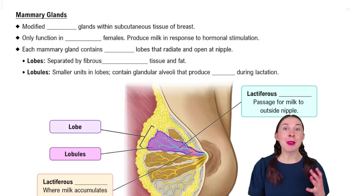
Prolactin is a hormone produced by the anterior pituitary gland that primarily stimulates milk production in the mammary glands after childbirth. It initiates and maintains lactation by promoting the synthesis of milk proteins and other components necessary for breastfeeding.
Video consigliato:
 2:54
2:54
Mammary Glands
Oxytocin and Milk Ejection Reflex
Oxytocin, released from the posterior pituitary, is responsible for the milk ejection or 'let-down' reflex. It causes the contraction of myoepithelial cells around the alveoli in the breast, enabling milk to be expelled through the ducts, but it does not initiate milk production.
Video consigliato:
 3:37
3:37Stretch Reflex
Hormonal Regulation of Lactation
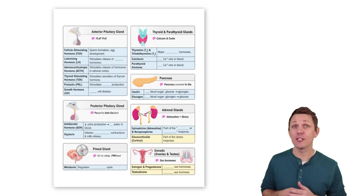
Lactation is regulated by a balance of hormones including estrogen, FSH, prolactin, and oxytocin. Estrogen and FSH primarily regulate reproductive functions, while prolactin initiates milk synthesis and oxytocin controls milk release, highlighting the distinct roles of these hormones in breastfeeding.
Video consigliato:
 13:06
13:06Review of Major Hormones
Pratica correlata