Ch. 28 Pregnancy and Human Development
Hoehn, Haynes, Abbott12th EditionMarieb Human Anatomy & PhysiologyISBN: 9780138242732
Non è quello che usi tu?Cambia libro di testoScegli un libro di testo diverso
TOC.tableOfContents
- Ch. 1 The Human Body: An Orientation25
- Ch. 2 Chemistry Comes Alive24
- Ch. 3 Cells: The Living Units24
- Ch. 4 Tissue: The Living Fabric19
- Ch. 5 The Integumentary System12
- Ch. 6 Bones and Skeletal Tissues19
- Ch. 7 The Skeleton14
- Ch. 8 Joints7
- Ch. 9 Muscles and Muscle Tissue26
- Ch. 10 The Muscular System25
- Ch. 11 Fundamentals of the Nervous System and Nervous Tissue23
- Ch. 12 The Central Nervous System25
- Ch. 13 The Peripheral Nervous System and Reflex Activity30
- Ch. 14 The Autonomic Nervous System16
- Ch. 15 The Special Senses26
- Ch. 16 The Endocrine System26
- Ch. 17 Blood27
- Ch. 18 The Cardiovascular System: The Heart25
- Ch. 19 The Cardiovascular System: Blood Vessels27
- Ch. 20 The Lymphatic System and Lymphoid Organs and Tissues16
- Ch. 21 The Immune System: Innate and Adaptive Body Defenses27
- Ch. 22 The Respiratory System21
- Ch. 23 The Digestive System31
- Ch. 24 Nutrition, Metabolism, and Energy Balance26
- Ch. 25 The Urinary System26
- Ch. 26 Fluid, Electrolyte, and Acid-Base Balance24
- Ch. 27 The Reproductive System24
- Ch. 28 Pregnancy and Human Development25
- Ch. 29 Heredity11
Hoehn, Haynes, Abbott12th EditionMarieb Human Anatomy & PhysiologyISBN: 9780138242732Non è quello che usi tu?Cambia libro di testo
Tutti i libri di testo Hoehn, Haynes, Abbott 12th EditionCh. 28 Pregnancy and Human DevelopmentProblema 14
Hoehn, Haynes, Abbott 12th EditionCh. 28 Pregnancy and Human DevelopmentProblema 14Capitolo 28, Problema 14
What is the function of hCG and why is it not important after the first trimester of pregnancy?
 Guida verificata passo dopo passo
1
Understand that hCG stands for human chorionic gonadotropin, a hormone produced by the placenta shortly after implantation.
Recognize that the primary function of hCG is to maintain the corpus luteum during the early stages of pregnancy, which in turn secretes progesterone to sustain the uterine lining.
Know that progesterone is crucial for maintaining a suitable environment for the developing embryo by preventing menstruation and supporting the endometrium.
Realize that after the first trimester, the placenta becomes fully developed and takes over progesterone production, making the role of hCG less critical.
Conclude that hCG levels typically decline after the first trimester because its main function—to support the corpus luteum and early progesterone production—is no longer necessary.
Concetti chiave
Ecco i concetti essenziali che devi comprendere per rispondere correttamente alla domanda.
Function of hCG (Human Chorionic Gonadotropin)
hCG is a hormone produced by the placenta shortly after implantation. Its primary role is to maintain the corpus luteum, which secretes progesterone to sustain the uterine lining and support early pregnancy. This hormone is crucial for the first trimester to prevent menstruation and promote embryo development.
Video consigliato:
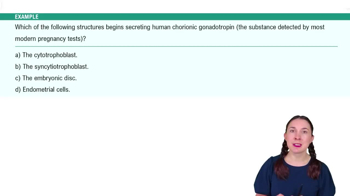
 1:04
1:04
Implantation Example 2
Role of the Corpus Luteum in Early Pregnancy
The corpus luteum is a temporary endocrine structure in the ovary that produces progesterone during early pregnancy. hCG signals the corpus luteum to continue progesterone production until the placenta can take over hormone secretion, ensuring the uterine environment remains suitable for fetal growth.
Video consigliato:
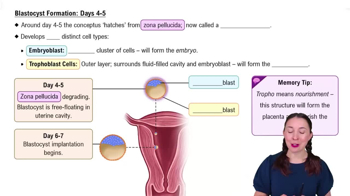 2:18
2:18Blastocyst Formation: Days 4-5
Placental Hormone Production After the First Trimester
After the first trimester, the placenta becomes fully developed and takes over progesterone and estrogen production from the corpus luteum. Because the placenta sustains hormone levels independently, hCG levels decline and its role becomes less critical for maintaining pregnancy beyond this stage.
Video consigliato:
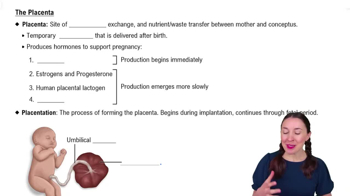 2:19
2:19The Placenta
Pratica correlata