
Ch. 5 The Integumentary System
Hoehn - Marieb Human Anatomy & Physiology, 12th edition
Hoehn, Haynes, Abbott12th EditionMarieb Human Anatomy & PhysiologyISBN: 9780138242732Non è quello che usi tu?Cambia libro di testo
Capitolo 5, Problema 8

Skin surface markings that reflect points of tight dermal attachment to underlying tissues are called
(a) tension lines,
(b) flexure lines,
(c) papillary ridges,
(d) dermal papillae.

Guida verificata passo dopo passo
1
Understand the terminology related to skin surface markings and their anatomical significance.
Recall that tension lines (also called Langer's lines) represent the natural orientation of collagen fibers in the dermis and indicate directions of skin tension, but they do not specifically mark points of tight dermal attachment.
Recognize that flexure lines are skin surface markings that occur where the skin is tightly bound to underlying structures, typically near joints, allowing for skin folding during movement.
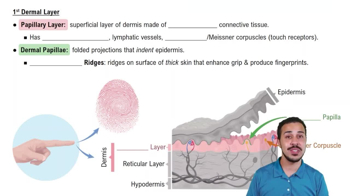
Identify that papillary ridges refer to the raised portions of the epidermis on fingertips and palms that form fingerprints, not points of dermal attachment.
Know that dermal papillae are projections of the dermis into the epidermis that increase surface area for nutrient exchange but are not surface markings indicating tight attachment points.

Risposta video verificata per un problema simile:

Questa soluzione video è stata consigliata dai nostri tutor come utile per risolvere questo problema.
Durata del video:
2m

Concetti chiave

Ecco i concetti essenziali che devi comprendere per rispondere correttamente alla domanda.

Tension Lines

Tension lines, also known as Langer's lines, are patterns on the skin that indicate the natural orientation of collagen fibers in the dermis. These lines reflect areas where the skin is under tension and are important in surgical incisions to minimize scarring.
Video consigliato:
Percorso guidato
1:56
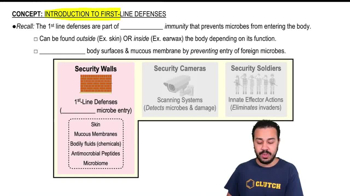
First-Line Defenses

Flexure Lines

Flexure lines are skin surface markings found near joints where the skin folds during movement. They correspond to points where the dermis is tightly bound to underlying structures, allowing the skin to crease without damage during flexion.
Video consigliato:
Percorso guidato
1:56
First-Line Defenses

Dermal Papillae

Dermal papillae are small, finger-like projections of the dermis that interlock with the epidermis, increasing surface area for nutrient exchange and strengthening the connection between layers. They contribute to skin texture but are not primarily responsible for tight attachments.
Video consigliato:
Percorso guidato
06:14
1st Dermal Layer