Ch. 11 Fundamentals of the Nervous System and Nervous Tissue
Marieb - Human Anatomy & Physiology 11th Edition
Marieb, Hoehn11th EditionHuman Anatomy & PhysiologyISBN: 9780136874034Non è quello che usi tu?Cambia libro di testo
Capitolo 11, Problema 18

What is the polarized membrane state? How is it maintained? (Note the relative roles of both passive and active mechanisms.)

Guida verificata passo dopo passo
1
Understand that the polarized membrane state refers to the difference in electrical charge across the plasma membrane of a cell, typically a neuron or muscle cell, where the inside of the cell is more negative relative to the outside.
Recognize that this polarization is primarily due to the unequal distribution of ions, especially sodium (Na\^+), potassium (K\^+), chloride (Cl\^-), and negatively charged proteins, across the membrane.
Identify the passive mechanisms that contribute to maintaining polarization, such as the selective permeability of the membrane to ions (mainly K\^+ leaking out of the cell) and the diffusion of ions down their concentration gradients through ion channels.
Explain the active mechanism, which is the sodium-potassium pump (Na\^+/K\^+ ATPase), that uses ATP energy to actively transport 3 Na\^+ ions out of the cell and 2 K\^+ ions into the cell, against their concentration gradients, helping to maintain the resting membrane potential.
Summarize that the polarized state is maintained by a balance between passive ion movement (diffusion and leakage) and active transport (Na\^+/K\^+ pump), which together establish and preserve the resting membrane potential essential for cell excitability.

Risposta video verificata per un problema simile:

Questa soluzione video è stata consigliata dai nostri tutor come utile per risolvere questo problema.
Durata del video:
1m

Concetti chiave

Ecco i concetti essenziali che devi comprendere per rispondere correttamente alla domanda.

Polarized Membrane State

The polarized membrane state refers to the difference in electrical charge across a cell's plasma membrane, typically with the inside being more negative relative to the outside. This resting membrane potential is essential for functions like nerve impulse transmission and muscle contraction.
Video consigliato:
04:15
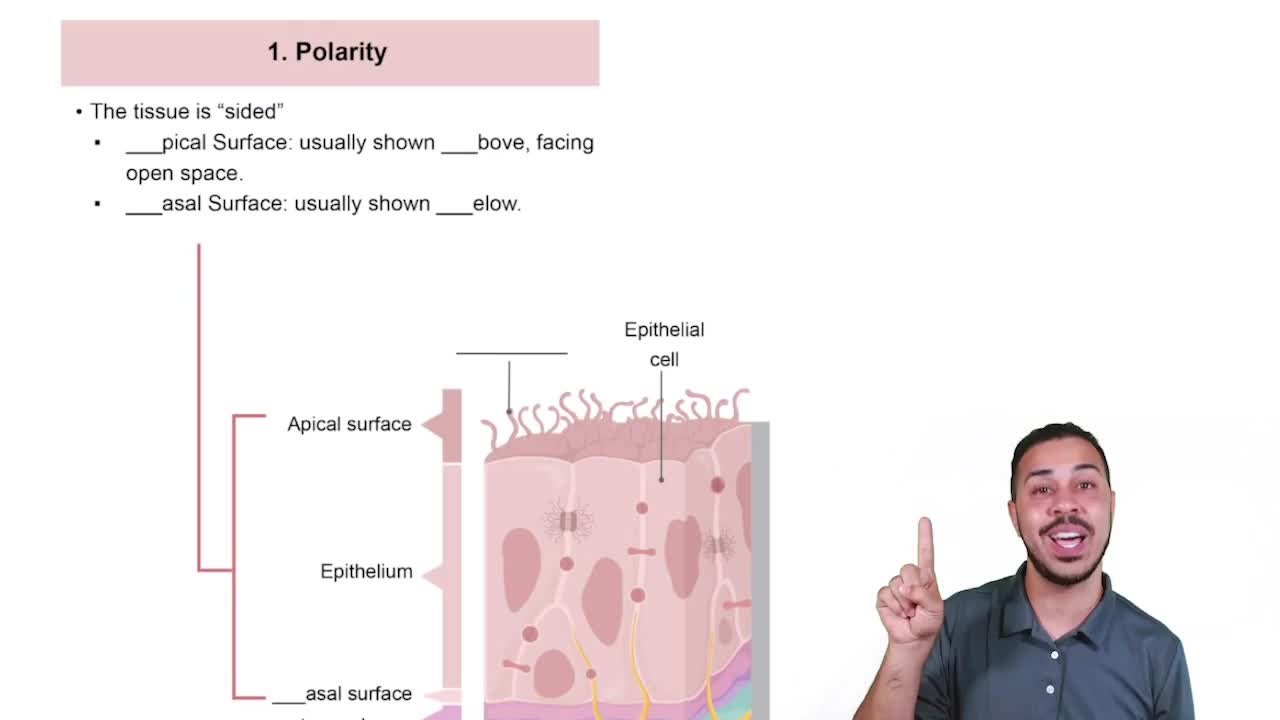
Characteristic 1: Polarity

Passive Mechanisms in Membrane Polarization

Passive mechanisms involve the movement of ions down their electrochemical gradients through ion channels, such as potassium ions leaking out of the cell. These movements help establish and maintain the resting membrane potential without energy expenditure.
Video consigliato:
Percorso guidato
05:05
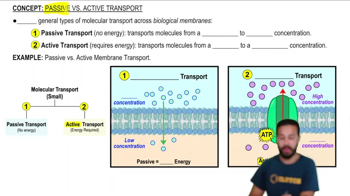
Passive vs. Active Transport

Active Mechanisms in Membrane Polarization

Active mechanisms use energy, primarily from ATP, to transport ions against their concentration gradients via pumps like the sodium-potassium ATPase. This pump moves sodium out and potassium into the cell, crucially maintaining ion gradients that sustain the polarized state.
Video consigliato:
Percorso guidato
02:37
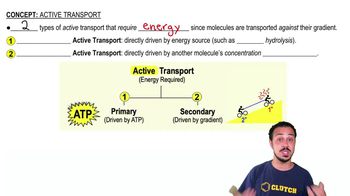
Active Transport