Ch. 13 The Peripheral Nervous System and Reflex Activity
Marieb - Human Anatomy & Physiology 11th Edition
Marieb, Hoehn11th EditionHuman Anatomy & PhysiologyISBN: 9780136874034Non è quello che usi tu?Cambia libro di testo
Capitolo 13, Problema 13

Differentiate between ipsilateral and contralateral reflexes.

Guida verificata passo dopo passo
1
Step 1: Understand the term 'reflex' as an automatic, involuntary response to a stimulus, often involving a sensory input and a motor output.
Step 2: Define 'ipsilateral reflex' as a reflex where the sensory input and motor output occur on the same side of the body.
Step 3: Define 'contralateral reflex' as a reflex where the sensory input occurs on one side of the body, but the motor output occurs on the opposite side.
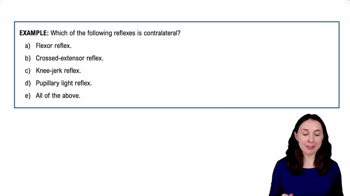
Step 4: Consider examples to clarify the difference: for ipsilateral reflex, the knee-jerk reflex is a good example where the stimulus and response are on the same leg; for contralateral reflex, the crossed extensor reflex is an example where the response occurs on the opposite side to maintain balance.
Step 5: Summarize by emphasizing that the key difference lies in the side of the body involved in the reflex arc—same side for ipsilateral and opposite side for contralateral reflexes.

Concetti chiave

Ecco i concetti essenziali che devi comprendere per rispondere correttamente alla domanda.

Ipsilateral Reflex

An ipsilateral reflex is a type of reflex action where the sensory input and motor output occur on the same side of the body. For example, when the right hand touches a hot object, the withdrawal reflex happens on the right side without involving the opposite side.
Video consigliato:
1:14
Reflex Arcs Example 3

Contralateral Reflex

A contralateral reflex involves a sensory input on one side of the body and a motor response on the opposite side. This type of reflex helps coordinate movements between both sides, such as the crossed extensor reflex that supports balance when one leg withdraws from a painful stimulus.
Video consigliato:
1:14
Reflex Arcs Example 3

Reflex Arc

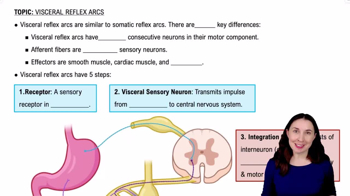
The reflex arc is the neural pathway that mediates a reflex action, including sensory neurons, interneurons, and motor neurons. Understanding the reflex arc is essential to differentiate ipsilateral and contralateral reflexes, as it explains how signals travel within the spinal cord to produce a response.
Video consigliato:
2:12
Visceral Reflex Arcs