Ch. 13 The Peripheral Nervous System and Reflex Activity
Marieb - Human Anatomy & Physiology 11th Edition
Marieb, Hoehn11th EditionHuman Anatomy & PhysiologyISBN: 9780136874034Non è quello che usi tu?Cambia libro di testo
Capitolo 13, Problema 11

List the structural components of the peripheral nervous system, and describe the function of each component.

Guida verificata passo dopo passo
1
Identify the main structural components of the peripheral nervous system (PNS), which include cranial nerves, spinal nerves, ganglia, and sensory receptors.
Describe cranial nerves as nerves that emerge directly from the brain and primarily serve the head and neck region, facilitating sensory and motor functions.
Explain spinal nerves as nerves that emerge from the spinal cord, responsible for transmitting sensory information to the central nervous system (CNS) and carrying motor commands to muscles and glands.
Define ganglia as clusters of neuron cell bodies located outside the CNS that act as relay points and processing centers for nerve signals within the PNS.
Describe sensory receptors as specialized structures that detect changes in the environment (stimuli) and convert them into nerve impulses to be sent to the CNS for processing.

Concetti chiave

Ecco i concetti essenziali che devi comprendere per rispondere correttamente alla domanda.

Peripheral Nervous System (PNS) Overview

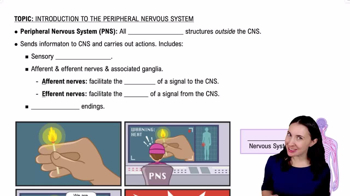
The peripheral nervous system consists of all nerves and ganglia outside the brain and spinal cord. It connects the central nervous system to limbs and organs, facilitating communication between the body and brain.
Video consigliato:
3:33
Peripheral Nervous System

Structural Components of the PNS

The main structural components of the PNS include cranial nerves, spinal nerves, ganglia, and sensory receptors. Cranial and spinal nerves transmit signals, ganglia contain neuron cell bodies, and sensory receptors detect stimuli.
Video consigliato:
5:04
Optic Components

Functions of PNS Components

Each PNS component has specific roles: cranial and spinal nerves carry motor and sensory information; ganglia process signals locally; sensory receptors detect environmental changes, enabling reflexes and voluntary responses.
Video consigliato:
5:04
Optic Components