Ch. 14 The Autonomic Nervous System
Marieb - Human Anatomy & Physiology 11th Edition
Marieb, Hoehn11th EditionHuman Anatomy & PhysiologyISBN: 9780136874034Non è quello che usi tu?Cambia libro di testo
Capitolo 14, Problema 4

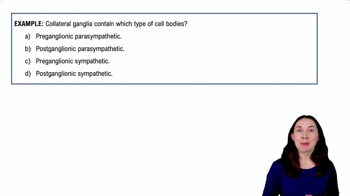
Collateral sympathetic ganglia are involved with innervating

Guida verificata passo dopo passo
1
Understand the concept of collateral sympathetic ganglia: These are part of the autonomic nervous system and are located outside the spinal cord, specifically in the abdominal cavity. They are responsible for relaying signals from the central nervous system to target organs.
Recognize the role of the sympathetic nervous system: It is responsible for the 'fight or flight' response, which includes increasing heart rate, dilating airways, and redirecting blood flow to essential organs during stress.
Identify the target organs innervated by collateral sympathetic ganglia: These ganglia primarily innervate abdominal and pelvic organs, such as the stomach, intestines, liver, kidneys, and reproductive organs.
Learn the specific ganglia involved: The major collateral sympathetic ganglia include the celiac ganglion, superior mesenteric ganglion, and inferior mesenteric ganglion. Each ganglion is associated with specific organs in the abdominal and pelvic regions.
Understand the pathway of innervation: Preganglionic neurons from the spinal cord synapse in the collateral ganglia, and postganglionic neurons extend from the ganglia to the target organs, delivering sympathetic signals to regulate their function.

Risposta video verificata per un problema simile:

Questa soluzione video è stata consigliata dai nostri tutor come utile per risolvere questo problema.
Durata del video:
1m

Concetti chiave

Ecco i concetti essenziali che devi comprendere per rispondere correttamente alla domanda.

Collateral Sympathetic Ganglia

Collateral sympathetic ganglia are clusters of nerve cell bodies located outside the spinal cord that are part of the autonomic nervous system. They play a crucial role in the sympathetic division, which is responsible for the body's 'fight or flight' response. These ganglia innervate various organs and tissues, influencing functions such as heart rate, blood pressure, and digestion.
Video consigliato:
1:23
Sympathetic Nervous System Example 5

Autonomic Nervous System

The autonomic nervous system (ANS) regulates involuntary physiological functions, including heart rate, blood pressure, respiration, and digestion. It is divided into the sympathetic and parasympathetic systems, with the sympathetic system preparing the body for stressful situations, while the parasympathetic system promotes rest and recovery. Understanding the ANS is essential for comprehending how collateral sympathetic ganglia function.
Video consigliato:
1:50
Somatic vs. Autonomic Nervous System

Innervation

Innervation refers to the supply of nerves to a specific body part, allowing for communication between the nervous system and various organs or tissues. In the context of collateral sympathetic ganglia, innervation involves the transmission of signals that regulate physiological responses, such as increasing heart rate or redirecting blood flow during stress. This concept is vital for understanding how the body responds to different stimuli.
Video consigliato:
02:35
Characteristic 3: Avascular but Innervated
Pratica correlata
Domanda del libro di testo

Which ANS fibers release acetylcholine? Which release norepinephrine?

1042
views
Domanda del libro di testo

The white rami communicantes contain what kind of fibers?

a. Preganglionic parasympathetic

b. Postganglionic parasympathetic

c. Preganglionic sympathetic

d. Postganglionic sympathetic

986
views
Domanda del libro di testo

Relate each of the following terms or phrases to either the sympathetic (S) or parasympathetic (P) division of the autonomic nervous system: 

______ (7) Generally short-duration action 

______ (8) Increases heart rate and blood pressure 

______ (9) Increases gastric motility and secretion of lacrimal, salivary, and digestive juices 

______ (10) Innervates blood vessels 

______ (11) Most active when you are relaxing in a hammock 

______ (12) Active when you are running in the Boston Marathon

765
views
Domanda del libro di testo

Where are the cell bodies of visceral sensory neurons?

1119
views
Domanda del libro di testo

Briefly explain why the following terms are sometimes used to refer to the autonomic nervous system: involuntary nervous system and emotional-visceral system.

815
views
1
rank
Domanda del libro di testo

Relate each of the following terms or phrases to either the sympathetic (S) or parasympathetic (P) division of the autonomic nervous system: 

______ (1) Short preganglionic, long postganglionic fibers 

______ (2) Intramural ganglia 

______ (3) Craniosacral part 

______ (4) Adrenergic fibers 

______ (5) Cervical ganglia 

______ (6) Otic and ciliary ganglia

874
views