
Domanda del libro di testo
Describe the appearance of platelets and state their major function
Why should platelets not be called 'cells'?
1322
views

 Guida verificata passo dopo passo
 10:05
10:05
 4:28
4:28Describe the appearance of platelets and state their major function
Why should platelets not be called 'cells'?
Define fibrinolysis
What is the importance of this process?
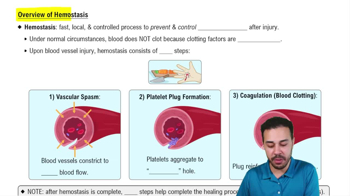
Define hemostasis
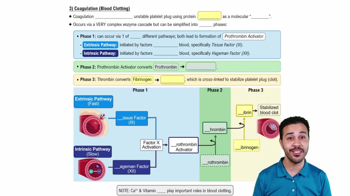
List the three major phases of coagulation. Explain what initiates each phase and what the phase accomplishes
In what general way do the intrinsic and extrinsic mechanisms of clotting differ?
Which ion is essential to virtually all stages of coagulation?
Alan Forsythe, a middle-aged college professor from Boston, is in the Swiss Alps studying astronomy during his sabbatical leave. He has been there for two days and plans to stay the entire year. However, he notices that he is short of breath when he walks up steps and tires easily with any physical activity. His symptoms gradually disappear, and he feels fine after less than a month. Upon returning to the United States, he has a complete physical exam and is told that his erythrocyte count is higher than normal.
a. Attempt to explain this finding.
b. Will his RBC count remain at this higher-than-normal level? Why or why not?
If you had a severe infection, would you expect your WBC count to be closest to 5000, 10,000, or 15,000/μl?
What is this condition called?
How can poor nutrition lead to anemia?