Ch. 18 The Cardiovascular System: The Heart
Marieb - Human Anatomy & Physiology 11th Edition
Marieb, Hoehn11th EditionHuman Anatomy & PhysiologyISBN: 9780136874034Non è quello che usi tu?Cambia libro di testo
Capitolo 18, Problema 3

An ECG provides information about:
a. Cardiac output
b. Movement of the excitation wave across the heart
c. Coronary circulation
d. Valve impairment

Guida verificata passo dopo passo
1
Step 1: Understand what an ECG (electrocardiogram) measures. An ECG records the electrical activity generated by the heart as it depolarizes and repolarizes during each heartbeat.
Step 2: Recognize that the ECG traces the movement of the excitation wave (electrical impulses) across the heart muscle, showing the timing and pattern of atrial and ventricular depolarization and repolarization.
Step 3: Analyze each option in the question: (a) Cardiac output refers to the volume of blood the heart pumps per minute, which is not directly measured by an ECG; (b) Movement of the excitation wave across the heart is exactly what the ECG records; (c) Coronary circulation involves blood flow through coronary arteries, which is not assessed by ECG; (d) Valve impairment relates to mechanical function of heart valves, which ECG does not directly evaluate.
Step 4: Conclude that the correct information provided by an ECG is related to the electrical activity and movement of the excitation wave across the heart.
Step 5: Summarize that the ECG is a tool for monitoring the heart's electrical conduction system, not mechanical output or blood flow.

Risposta video verificata per un problema simile:

Questa soluzione video è stata consigliata dai nostri tutor come utile per risolvere questo problema.
Durata del video:
2m

Concetti chiave

Ecco i concetti essenziali che devi comprendere per rispondere correttamente alla domanda.

Electrocardiogram (ECG) Basics

An ECG records the electrical activity of the heart over time, capturing the excitation waves generated by cardiac muscle depolarization and repolarization. It provides a graphical representation of the heart's rhythm and conduction patterns but does not directly measure mechanical functions like output or valve status.
Video consigliato:
4:36
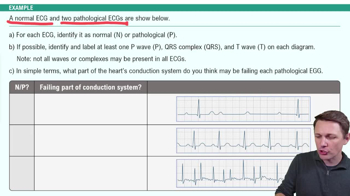
Electrocardiogram (ECG) Example 2

Excitation Wave Propagation in the Heart

The excitation wave refers to the electrical impulses that travel through the heart's conduction system, triggering muscle contraction. The ECG traces these waves as they move across the atria and ventricles, allowing assessment of the timing and sequence of cardiac electrical activity.
Video consigliato:
03:50
Types of Propagation: Continuous Conduction

Limitations of ECG in Assessing Cardiac Function

While ECG provides electrical information, it does not directly measure cardiac output, coronary blood flow, or valve function. These aspects require other diagnostic tools like echocardiography or angiography, as ECG cannot visualize mechanical or circulatory parameters.
Video consigliato:
9:24
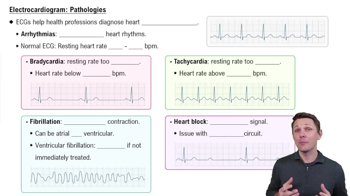
Electrocardiogram: Pathologies