Ch. 19 The Cardiovascular System: Blood Vessels
Marieb - Human Anatomy & Physiology 11th Edition
Marieb, Hoehn11th EditionHuman Anatomy & PhysiologyISBN: 9780136874034Non è quello che usi tu?Cambia libro di testo
Capitolo 19, Problema 2

Total peripheral resistance:
a. is inversely proportional to the length of the vascular bed
b. increases in anemia
c. decreases in polycythemia
d. is inversely related to the diameter of the arterioles

Guida verificata passo dopo passo
1
Step 1: Understand the concept of total peripheral resistance (TPR). TPR is the resistance to blood flow offered by all of the systemic vasculature, primarily influenced by the diameter and length of blood vessels, and blood viscosity.
Step 2: Recall that TPR is directly proportional to the length of the vascular bed, meaning that as the length increases, resistance increases. Therefore, it is not inversely proportional to length.
Step 3: Consider the effect of anemia and polycythemia on blood viscosity. Anemia decreases blood viscosity, which tends to decrease TPR, while polycythemia increases blood viscosity, which tends to increase TPR.
Step 4: Recognize that vessel diameter, especially of arterioles, has a strong inverse relationship with resistance. According to Poiseuille's law, resistance is inversely proportional to the fourth power of the vessel radius (or diameter), so smaller diameter means higher resistance.
Step 5: Use these principles to evaluate each option: (a) is incorrect because TPR is directly proportional to length; (b) is incorrect because anemia decreases viscosity and thus TPR; (c) is incorrect because polycythemia increases viscosity and TPR; (d) is correct because TPR is inversely related to arteriole diameter.

Risposta video verificata per un problema simile:

Questa soluzione video è stata consigliata dai nostri tutor come utile per risolvere questo problema.
Durata del video:
1m

Concetti chiave

Ecco i concetti essenziali che devi comprendere per rispondere correttamente alla domanda.

Total Peripheral Resistance (TPR)

TPR refers to the overall resistance to blood flow offered by the systemic blood vessels, primarily arterioles. It is a key determinant of blood pressure and is influenced by vessel diameter, blood viscosity, and vessel length.
Video consigliato:
3:33
Peripheral Nervous System

Relationship Between Vessel Diameter and Resistance

Resistance to blood flow is inversely related to the fourth power of the vessel radius, meaning small changes in arteriole diameter greatly affect TPR. Narrower arterioles increase resistance, while wider arterioles decrease it.
Video consigliato:
Percorso guidato
6:40
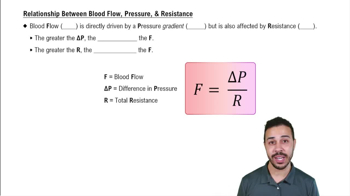
Relationship Between Blood Flow, Pressure, & Resistance

Effect of Blood Viscosity on Resistance

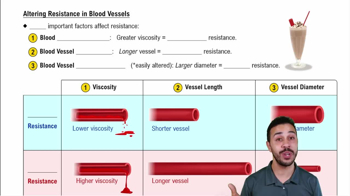
Blood viscosity, influenced by factors like hematocrit, affects TPR. Anemia (low red blood cells) decreases viscosity and resistance, while polycythemia (high red blood cells) increases viscosity and resistance.
Video consigliato:
Percorso guidato
8:32
Altering Resistance in Blood Vessels