Ch. 2 Chemistry Comes Alive
Marieb - Human Anatomy & Physiology 11th Edition
Marieb, Hoehn11th EditionHuman Anatomy & PhysiologyISBN: 9780136874034Non è quello che usi tu?Cambia libro di testo
Capitolo 2, Problema 6

When a pair of electrons is shared between two atoms, the bond formed is called:
a. A single covalent bond
b. A double covalent bond
c. A triple covalent bond
d. An ionic bond

Guida verificata passo dopo passo
1
Understand that a covalent bond involves the sharing of electrons between atoms to achieve stability.
Recall that a single covalent bond is formed when one pair of electrons (two electrons) is shared between two atoms.
Recognize that a double covalent bond involves two pairs of electrons (four electrons) being shared, and a triple covalent bond involves three pairs (six electrons).
Differentiate covalent bonds from ionic bonds, where electrons are transferred rather than shared.
Conclude that when a pair of electrons is shared between two atoms, the bond formed is a single covalent bond.

Risposta video verificata per un problema simile:

Questa soluzione video è stata consigliata dai nostri tutor come utile per risolvere questo problema.
Durata del video:
2m

Concetti chiave

Ecco i concetti essenziali che devi comprendere per rispondere correttamente alla domanda.

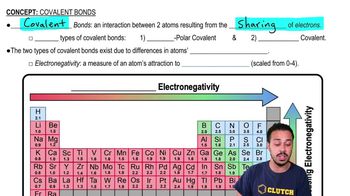
Covalent Bond

A covalent bond is a chemical bond formed when two atoms share one or more pairs of electrons. This sharing allows each atom to achieve a stable electron configuration, typically resembling that of noble gases.
Video consigliato:

Single, Double, and Triple Covalent Bonds

These terms describe the number of electron pairs shared between two atoms: a single bond shares one pair, a double bond shares two pairs, and a triple bond shares three pairs. The bond type affects the molecule's strength and properties.
Video consigliato:

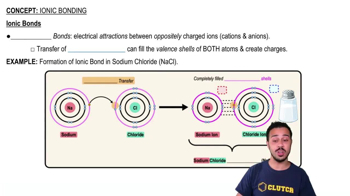
Ionic Bond

An ionic bond forms when one atom donates electrons to another, resulting in oppositely charged ions that attract each other. Unlike covalent bonds, ionic bonds involve electron transfer rather than sharing.
Video consigliato: