Ch. 20 The Lymphatic System and Lymphoid Organs and Tissues
Marieb - Human Anatomy & Physiology 11th Edition
Marieb, Hoehn11th EditionHuman Anatomy & PhysiologyISBN: 9780136874034Non è quello che usi tu?Cambia libro di testo
Capitolo 20, Problema 3

Entry of lymph into the lymphatic capillaries is promoted by which of the following?
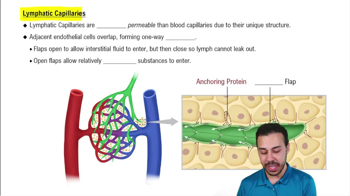
a. One-way minivalves formed by overlapping endothelial cells
b. The respiratory pump
c. The skeletal muscle pump
d. Greater fluid pressure in the interstitial space

Guida verificata passo dopo passo
1
Understand the structure of lymphatic capillaries: they have overlapping endothelial cells that act like one-way minivalves, allowing fluid to enter but preventing it from leaving.
Recognize that the respiratory pump and skeletal muscle pump assist lymph movement in larger lymphatic vessels but do not directly promote entry into the lymphatic capillaries.
Consider the role of fluid pressure: greater fluid pressure in the interstitial space helps push fluid into the lymphatic capillaries through the minivalves.
Combine these concepts to identify that the entry of lymph into lymphatic capillaries is primarily promoted by the one-way minivalves formed by overlapping endothelial cells, which open when interstitial fluid pressure is higher.
Conclude that the correct mechanism involves the structural feature of the lymphatic capillaries (the minivalves) responding to pressure differences to allow lymph entry.

Risposta video verificata per un problema simile:

Questa soluzione video è stata consigliata dai nostri tutor come utile per risolvere questo problema.
Durata del video:
3m

Concetti chiave

Ecco i concetti essenziali che devi comprendere per rispondere correttamente alla domanda.

Structure and Function of Lymphatic Capillaries

Lymphatic capillaries are tiny, blind-ended vessels with overlapping endothelial cells that form one-way minivalves. These minivalves open when interstitial fluid pressure is high, allowing fluid to enter but preventing backflow, thus promoting lymph entry into the lymphatic system.
Video consigliato:
Percorso guidato
3:46
Lymphatic Capillaries

Role of Pressure Gradients in Lymph Formation

Fluid movement into lymphatic capillaries depends on pressure differences between the interstitial space and the lymphatic lumen. Higher pressure in the interstitial fluid pushes fluid into the capillaries, aided by the minivalves, facilitating lymph formation.
Video consigliato:
Percorso guidato
04:51
Concentration Gradients and Diffusion

Mechanisms Assisting Lymph Flow: Respiratory and Skeletal Muscle Pumps

The respiratory pump and skeletal muscle pump help propel lymph through larger lymphatic vessels by creating pressure changes during breathing and muscle contractions. However, they do not directly promote fluid entry into lymphatic capillaries.
Video consigliato:
7:12
Organization of Muscle Tissue