Ch. 22 The Respiratory System
Marieb - Human Anatomy & Physiology 11th Edition
Marieb, Hoehn11th EditionHuman Anatomy & PhysiologyISBN: 9780136874034Non è quello che usi tu?Cambia libro di testo
Capitolo 22, Problema 7

The nutrient blood supply of the lungs is provided by:
a. The pulmonary arteries
b. The aorta
c. The pulmonary veins
d. The bronchial arteries

Guida verificata passo dopo passo
1
Understand the difference between the functional and nutrient blood supply of the lungs. The functional blood supply is provided by the pulmonary arteries and veins, which are involved in gas exchange. The nutrient blood supply, however, provides oxygen and nutrients to the lung tissue itself.
Recall that the pulmonary arteries carry deoxygenated blood from the heart to the lungs for oxygenation, and the pulmonary veins return oxygenated blood to the heart. These vessels are part of the functional blood supply, not the nutrient supply.
Consider the bronchial arteries, which branch off from the aorta. These arteries are responsible for delivering oxygenated blood to the lung tissue, including the bronchi and connective tissue, as part of the nutrient blood supply.
Eliminate options that do not align with the nutrient blood supply. For example, the pulmonary arteries and veins are part of the functional blood supply, not the nutrient supply.
Conclude that the bronchial arteries, which originate from the aorta, are the correct answer for providing the nutrient blood supply to the lungs.

Risposta video verificata per un problema simile:

Questa soluzione video è stata consigliata dai nostri tutor come utile per risolvere questo problema.
Durata del video:
2m

Concetti chiave

Ecco i concetti essenziali che devi comprendere per rispondere correttamente alla domanda.

Pulmonary Circulation

Pulmonary circulation refers to the pathway in which deoxygenated blood is transported from the right side of the heart to the lungs via the pulmonary arteries. In the lungs, carbon dioxide is exchanged for oxygen, and the now oxygenated blood returns to the left side of the heart through the pulmonary veins. This process is essential for oxygenating blood before it is distributed to the rest of the body.
Video consigliato:
3:49
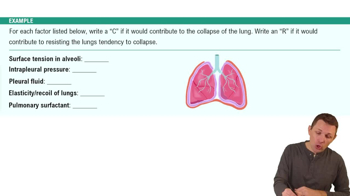
Pressure in the Lungs and Pleural Cavity Example 1

Bronchial Arteries

Bronchial arteries are responsible for supplying oxygenated blood to the tissues of the lungs themselves, including the bronchi and bronchioles. Unlike the pulmonary arteries, which carry deoxygenated blood to the lungs, bronchial arteries branch off from the aorta and ensure that the lung tissues receive the necessary nutrients and oxygen for their metabolic needs.
Video consigliato:
Percorso guidato
14:43
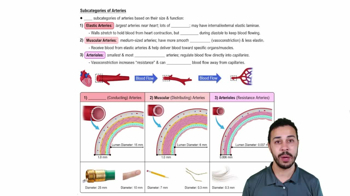
Subcategories of Arteries

Oxygenation Process

The oxygenation process occurs in the alveoli of the lungs, where oxygen from inhaled air diffuses into the blood while carbon dioxide diffuses out to be exhaled. This exchange is crucial for maintaining the body's oxygen levels and removing waste gases. Understanding this process helps clarify the role of the pulmonary arteries and veins in the circulatory system.
Video consigliato:
Percorso guidato
04:19
1) RNA Processing