Ch. 24 Nutrition, Metabolism, and Energy Balance
Marieb - Human Anatomy & Physiology 11th Edition
Marieb, Hoehn11th EditionHuman Anatomy & PhysiologyISBN: 9780136874034Non è quello che usi tu?Cambia libro di testo
Capitolo 24, Problema 21

Calculate the number of ATP molecules that can be harvested during the complete oxidation of an 18-carbon fatty acid.

Guida verificata passo dopo passo
1
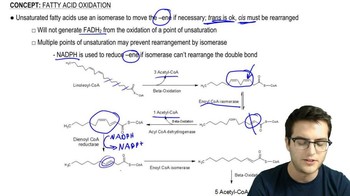
Step 1: Understand the process of fatty acid oxidation. Fatty acids are broken down through beta-oxidation, which occurs in the mitochondria. Each cycle of beta-oxidation removes two carbons from the fatty acid chain, producing acetyl-CoA, NADH, and FADH2.
Step 2: Determine the number of beta-oxidation cycles required for an 18-carbon fatty acid. Since each cycle removes two carbons, divide the total number of carbons (18) by 2 to find the number of acetyl-CoA molecules produced. Subtract 1 from this number to find the number of beta-oxidation cycles.
Step 3: Calculate the ATP yield from beta-oxidation. Each beta-oxidation cycle produces 1 NADH and 1 FADH2. Use the following approximate ATP yields: 1 NADH = 2.5 ATP and 1 FADH2 = 1.5 ATP. Multiply the number of beta-oxidation cycles by these values to find the total ATP from NADH and FADH2.
Step 4: Calculate the ATP yield from acetyl-CoA. Each acetyl-CoA enters the citric acid cycle (Krebs cycle), producing 3 NADH, 1 FADH2, and 1 GTP (equivalent to 1 ATP). Multiply the number of acetyl-CoA molecules by these values to find the total ATP from the citric acid cycle.
Step 5: Account for the energy cost of fatty acid activation. Before beta-oxidation begins, the fatty acid must be activated, which requires 2 ATP molecules. Subtract this energy cost from the total ATP yield calculated in the previous steps to find the net ATP production.

Risposta video verificata per un problema simile:

Questa soluzione video è stata consigliata dai nostri tutor come utile per risolvere questo problema.
Durata del video:
2m

Concetti chiave

Ecco i concetti essenziali che devi comprendere per rispondere correttamente alla domanda.

Beta-Oxidation

Beta-oxidation is the metabolic process by which fatty acids are broken down in the mitochondria to generate acetyl-CoA. Each cycle of beta-oxidation shortens the fatty acid chain by two carbon atoms, producing one molecule of acetyl-CoA, which then enters the citric acid cycle for further energy extraction.
Video consigliato:
Percorso guidato
08:55
Fatty Acid Oxidation 2

Citric Acid Cycle (Krebs Cycle)

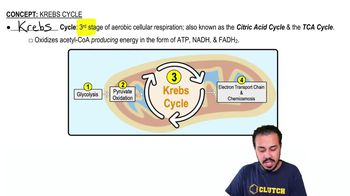
The citric acid cycle is a series of chemical reactions used by all aerobic organisms to generate energy through the oxidation of acetyl-CoA. Each turn of the cycle produces ATP, NADH, and FADH2, which are crucial for the electron transport chain, ultimately leading to the production of additional ATP.
Video consigliato:

Electron Transport Chain (ETC)

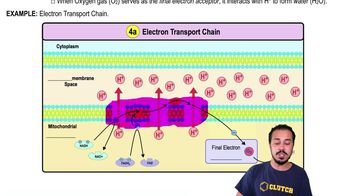
The electron transport chain is a series of protein complexes located in the inner mitochondrial membrane that transfer electrons from NADH and FADH2 to oxygen, creating a proton gradient. This gradient drives ATP synthesis through ATP synthase, yielding a significant amount of ATP from the oxidation of fatty acids and other substrates.
Video consigliato:
Percorso guidato
07:41
Electron Transport Chain