Ch. 3 Cells: The Living Units
Marieb - Human Anatomy & Physiology 11th Edition
Marieb, Hoehn11th EditionHuman Anatomy & PhysiologyISBN: 9780136874034Non è quello che usi tu?Cambia libro di testo
Capitolo 3, Problema 21

Cell division typically yields two daughter cells, each with one nucleus. How is the occasional binucleate condition of liver cells explained?

Guida verificata passo dopo passo
1
Understand that a binucleate cell contains two nuclei within a single cell membrane, which is different from the typical condition where each daughter cell has one nucleus after cell division.
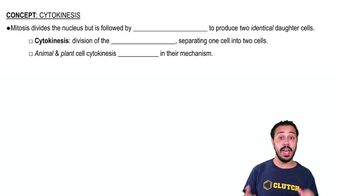
Recall the process of mitosis followed by cytokinesis: mitosis divides the nucleus, and cytokinesis divides the cytoplasm, resulting in two separate cells each with one nucleus.
Recognize that in some liver cells, mitosis occurs normally, but cytokinesis is incomplete or delayed, leading to one cell with two nuclei instead of two separate cells.
Consider the physiological reasons why liver cells might become binucleate, such as increased metabolic demand or a mechanism to enhance protein synthesis without increasing cell number.
Summarize that the binucleate condition arises from nuclear division without complete cytoplasmic division, a phenomenon known as karyokinesis without cytokinesis.

Risposta video verificata per un problema simile:

Questa soluzione video è stata consigliata dai nostri tutor come utile per risolvere questo problema.
Durata del video:
2m

Concetti chiave

Ecco i concetti essenziali che devi comprendere per rispondere correttamente alla domanda.

Mitosis and Cytokinesis

Mitosis is the process where a cell's nucleus divides to form two nuclei, while cytokinesis is the division of the cytoplasm, resulting in two separate daughter cells. If cytokinesis fails or is incomplete after mitosis, a cell may end up with two nuclei, leading to a binucleate condition.
Video consigliato:

Binucleate Cells in Liver Tissue

Liver cells (hepatocytes) often become binucleate as a normal physiological adaptation. This occurs because hepatocytes can undergo nuclear division without completing cytokinesis, which may enhance their metabolic capacity and regenerative potential.
Video consigliato:
Percorso guidato
1:35
Lymphoid Cells & Tissues Example 1

Polyploidy and Cellular Function

Binucleate cells are related to polyploidy, where cells have multiple sets of chromosomes. In the liver, polyploidy and binucleation help cells manage increased metabolic demands and contribute to tissue regeneration and repair.
Video consigliato:
Percorso guidato
06:04
Functional Groups