Ch. 3 Cells: The Living Units
Marieb - Human Anatomy & Physiology 11th Edition
Marieb, Hoehn11th EditionHuman Anatomy & PhysiologyISBN: 9780136874034Non è quello che usi tu?Cambia libro di testo
Capitolo 3, Problema 6

The nuclear substance composed of histone proteins and DNA is:
a. Chromatin
b. The nucleolus
c. Nucleoplasm
d. Nuclear pores

Guida verificata passo dopo passo
1
Understand the components of the cell nucleus: The nucleus contains DNA, proteins, nucleolus, nucleoplasm, and nuclear pores, each with distinct functions.
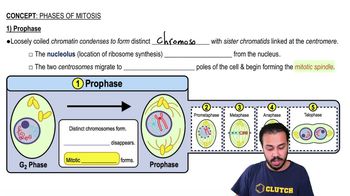
Recall that DNA in the nucleus is wrapped around proteins called histones to form a complex substance that helps organize and compact the DNA.
Identify that this complex of DNA and histone proteins is known as chromatin, which is the material that makes up chromosomes during cell division.
Recognize that the nucleolus is a dense region within the nucleus involved in ribosomal RNA synthesis, not the DNA-protein complex.
Note that nucleoplasm is the fluid inside the nucleus, and nuclear pores are openings in the nuclear envelope, so neither refers to the DNA-histone complex.

Risposta video verificata per un problema simile:

Questa soluzione video è stata consigliata dai nostri tutor come utile per risolvere questo problema.
Durata del video:
2m

Concetti chiave

Ecco i concetti essenziali che devi comprendere per rispondere correttamente alla domanda.

Chromatin

Chromatin is the complex of DNA and histone proteins found in the nucleus of eukaryotic cells. It packages DNA into a compact, organized structure, allowing efficient regulation of gene expression and DNA replication.
Video consigliato:

Histone Proteins

Histones are positively charged proteins around which DNA winds to form nucleosomes, the basic units of chromatin. They play a key role in DNA packaging and gene regulation by controlling access to genetic information.
Video consigliato:

Nuclear Components

The nucleus contains several components: nucleoplasm (the fluid matrix), nucleolus (site of ribosome synthesis), and nuclear pores (channels for molecular transport). Understanding these helps distinguish chromatin from other nuclear structures.
Video consigliato:
5:04
Optic Components