Ch. 4 Tissue: The Living Fabric
Marieb - Human Anatomy & Physiology 11th Edition
Marieb, Hoehn11th EditionHuman Anatomy & PhysiologyISBN: 9780136874034Non è quello che usi tu?Cambia libro di testo
Capitolo 4, Problema 13

Matrix is extracellular. How does the matrix get to its characteristic position?

Guida verificata passo dopo passo
1
Understand that the extracellular matrix (ECM) is produced and secreted by the cells that reside within a tissue, such as fibroblasts in connective tissue.
Recognize that the matrix components, including proteins like collagen, elastin, and glycoproteins, are synthesized inside the cell and then transported to the extracellular space via exocytosis.
Learn that once secreted, these matrix molecules self-assemble or organize in the extracellular space, guided by interactions with cell surface receptors and other matrix components.
Consider the role of cell adhesion molecules and integrins, which help anchor the matrix to the cell surface, ensuring the matrix is positioned correctly relative to the cells.
Appreciate that the dynamic remodeling of the matrix by enzymes such as matrix metalloproteinases also helps maintain the matrix's characteristic structure and position over time.

Risposta video verificata per un problema simile:

Questa soluzione video è stata consigliata dai nostri tutor come utile per risolvere questo problema.
Durata del video:
1m

Concetti chiave

Ecco i concetti essenziali che devi comprendere per rispondere correttamente alla domanda.

Extracellular Matrix (ECM)

The extracellular matrix is a complex network of proteins and polysaccharides secreted by cells into the space outside the cell membrane. It provides structural support and biochemical signals to surrounding cells, influencing tissue development and function.
Video consigliato:
3:31
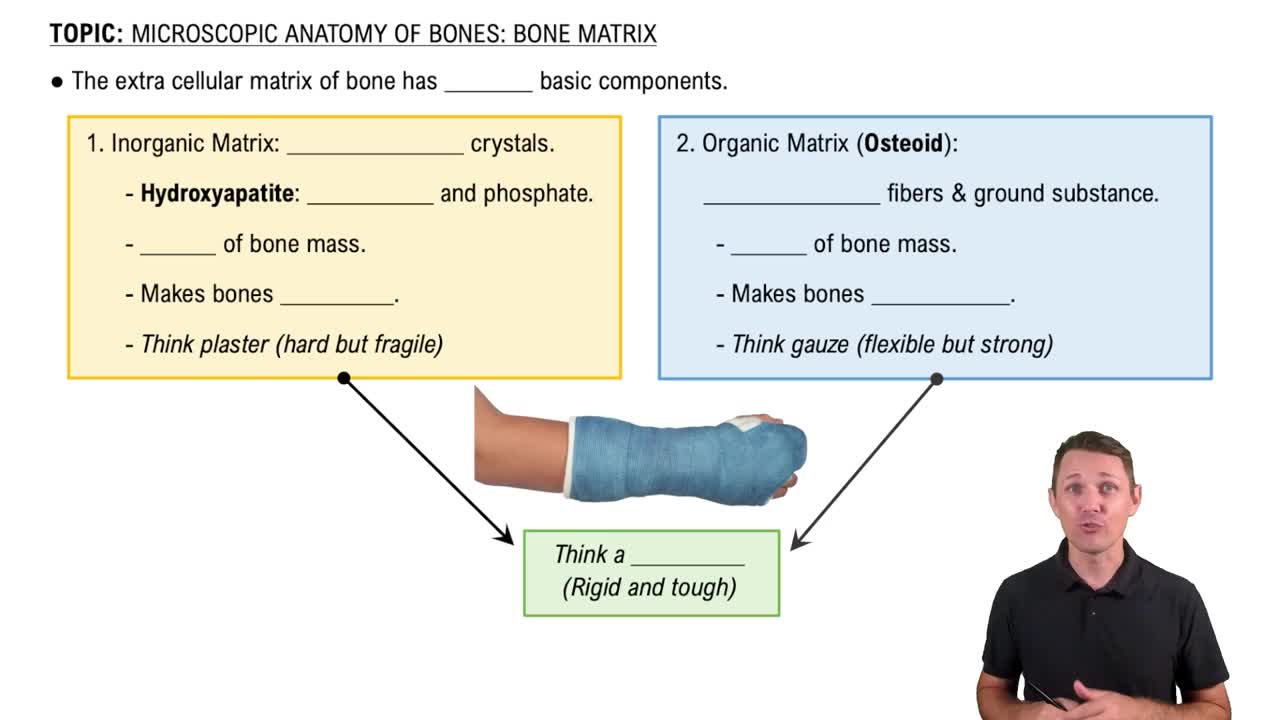
Bone Matrix

Secretion and Transport of Matrix Components

Cells synthesize matrix molecules internally and transport them via vesicles to the cell surface, where they are secreted into the extracellular space. This process ensures that matrix components reach their characteristic positions outside the cells.
Video consigliato:
3:31
Bone Matrix

Matrix Assembly and Organization

Once secreted, matrix molecules self-assemble and interact with each other and cell surface receptors to form a structured and functional matrix. This organization determines the matrix’s characteristic position and mechanical properties in tissues.
Video consigliato:
3:31
Bone Matrix