Ch. 6 Bones and Skeletal Tissues
Marieb - Human Anatomy & Physiology 11th Edition
Marieb, Hoehn11th EditionHuman Anatomy & PhysiologyISBN: 9780136874034Non è quello che usi tu?Cambia libro di testo
Capitolo 6, Problema 17

Why do you think wheelchair-bound people with paralyzed lower limbs have thin, weak bones of the leg and thigh?

Guida verificata passo dopo passo
1
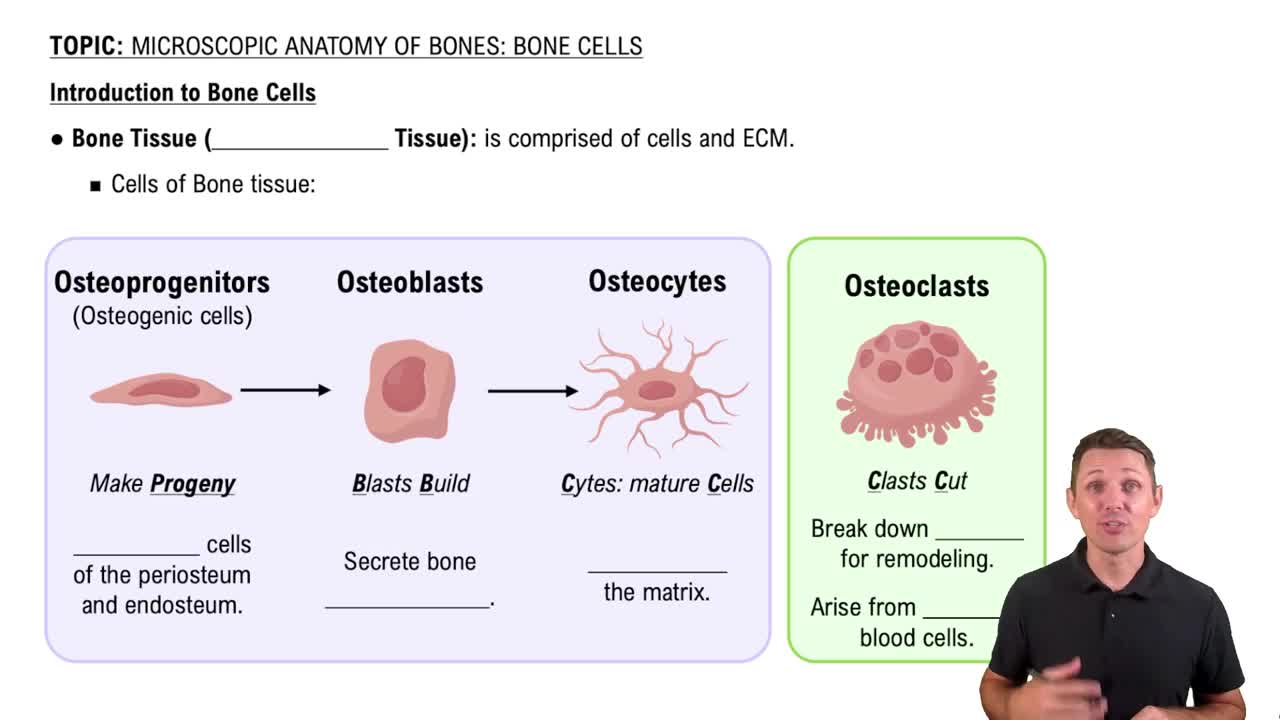
Understand that bones require mechanical stress or weight-bearing activity to maintain their density and strength, a concept known as Wolff's Law.
Recognize that in wheelchair-bound individuals with paralyzed lower limbs, the legs and thighs do not experience normal weight-bearing forces due to lack of movement and muscle contractions.
Identify that the absence of mechanical stress leads to decreased stimulation of bone-forming cells (osteoblasts) and increased activity of bone-resorbing cells (osteoclasts), resulting in bone loss or osteoporosis.
Connect that this bone loss manifests as thinner, weaker bones in the legs and thighs because the skeletal system adapts to the reduced functional demand.
Conclude that maintaining bone strength requires regular mechanical loading, which is absent in paralyzed limbs, explaining the observed bone thinning and weakness.

Risposta video verificata per un problema simile:

Questa soluzione video è stata consigliata dai nostri tutor come utile per risolvere questo problema.
Durata del video:
3m

Concetti chiave

Ecco i concetti essenziali che devi comprendere per rispondere correttamente alla domanda.

Bone Remodeling and Mechanical Stress

Bone remodeling is a continuous process where bone tissue is broken down and rebuilt. Mechanical stress from weight-bearing activities stimulates bone formation, maintaining bone density and strength. Without regular stress, bones lose mass and become weaker.
Video consigliato:
4:19
Introduction to Bone Cells

Effects of Immobilization on Bone Health

Immobilization or lack of movement, such as in wheelchair-bound individuals, reduces mechanical loading on bones. This leads to decreased bone formation and increased bone resorption, causing bones to become thin, fragile, and prone to fractures.
Video consigliato:
Percorso guidato
1:32
Effects of the Complement System

Impact of Paralysis on Musculoskeletal System

Paralysis of lower limbs results in muscle atrophy and reduced stimulation of bones due to inactivity. The lack of muscle contractions and weight-bearing activities diminishes bone strength and density, contributing to weaker bones in the legs and thighs.
Video consigliato:
Percorso guidato
4:25
Complement System
Pratica correlata
Domanda del libro di testo

Compare bone to cartilage tissue relative to its resilience, speed of regeneration, and access to nutrients.

838
views
Domanda del libro di testo

Compare and contrast controls of bone remodeling exerted by hormones and by mechanical and gravitational forces, including the purpose of each control system and changes in bone architecture that might occur.

532
views
Domanda del libro di testo

(a) During what period of life does skeletal mass increase dramatically? Begin to decline?

(b) Why are fractures most common in elderly individuals?

(c) Why are greenstick fractures most common in children?

33
views
Domanda del libro di testo

Describe the process of new bone formation in an adult bone. Use the terms "osteoid seam" and "calcification front" in your discussion.

946
views
Domanda del libro di testo

Mrs. Abbruzzo brought her 4-year-old daughter to the doctor, complaining that she didn't 'look right.' The child's forehead was enlarged, her rib cage was knobby, and her lower limbs were bent and deformed. X rays revealed very thick epiphyseal plates. Mrs. Abbruzzo was advised to increase dietary amounts of vitamin D and milk and to get the girl outside to play in the sun. Considering the child's signs and symptoms, what disease do you think she has? Explain the doctor's instructions.

987
views
Domanda del libro di testo

Yolanda is asked to review a bone slide that her professor has set up under the microscope. She sees concentric layers surrounding a central cavity. Is this bone section taken from the diaphysis or the epiphyseal plate of the specimen?

844
views
1
rank