Ch. 7 The Skeleton
Marieb - Human Anatomy & Physiology 11th Edition
Marieb, Hoehn11th EditionHuman Anatomy & PhysiologyISBN: 9780136874034Non è quello che usi tu?Cambia libro di testo
Capitolo 7, Problema 9

How do the relative proportions of the cranium and face of a fetus compare with those of an adult skull?

Guida verificata passo dopo passo
1
Step 1: Understand the basic anatomy of the skull, which is divided into two main parts: the cranium (which houses the brain) and the face (which includes the jaw, nose, and other facial bones).
Step 2: Recognize that during fetal development, the cranium is proportionally much larger compared to the face because the brain grows rapidly and requires more space early on.
Step 3: Note that in a fetus, the face is relatively small and underdeveloped compared to the cranium, reflecting the priority of brain growth over facial bone growth at this stage.
Step 4: Contrast this with the adult skull, where the face has grown significantly and the proportions between the cranium and face are more balanced, with the face being larger relative to the cranium than in the fetus.
Step 5: Summarize that the relative proportion of the cranium to the face decreases from fetus to adult, meaning the cranium is larger relative to the face in the fetus, while in adults, the face is proportionally larger compared to the cranium.

Risposta video verificata per un problema simile:

Questa soluzione video è stata consigliata dai nostri tutor come utile per risolvere questo problema.
Durata del video:
2m

Concetti chiave

Ecco i concetti essenziali che devi comprendere per rispondere correttamente alla domanda.

Cranial and Facial Proportions in Fetal Development

In fetal development, the cranium is proportionally larger compared to the face, reflecting early brain growth. This results in a relatively large forehead and small facial bones. Understanding this helps explain the distinct skull shape differences between fetuses and adults.
Video consigliato:
4:36
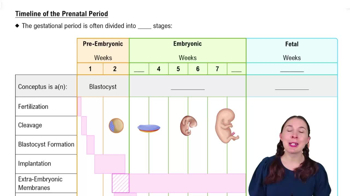
Timeline of the Prenatal Period

Postnatal Growth Patterns of the Skull

After birth, the face grows more rapidly than the cranium, especially during childhood and adolescence. This differential growth changes the relative proportions, making the adult skull have a larger face relative to the cranium compared to the fetal skull.
Video consigliato:
4:42
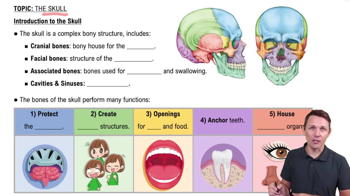
Introduction to the Skull

Functional and Evolutionary Implications of Skull Proportions

The larger fetal cranium accommodates rapid brain development, while the smaller face reflects less developed jaws and sensory structures. In adults, increased facial size supports functions like mastication and respiration, illustrating how skull proportions relate to developmental and functional needs.
Video consigliato:
4:42
Introduction to the Skull