Ch. 9 Muscles and Muscle Tissue
Marieb - Human Anatomy & Physiology 11th Edition
Marieb, Hoehn11th EditionHuman Anatomy & PhysiologyISBN: 9780136874034Non è quello che usi tu?Cambia libro di testo
Capitolo 9, Problema 11

The ions that enter the skeletal muscle cell during the generation of an action potential are
a. Calcium ions
b. Chloride ions
c. Sodium ions
d. Potassium ions

Guida verificata passo dopo passo
1
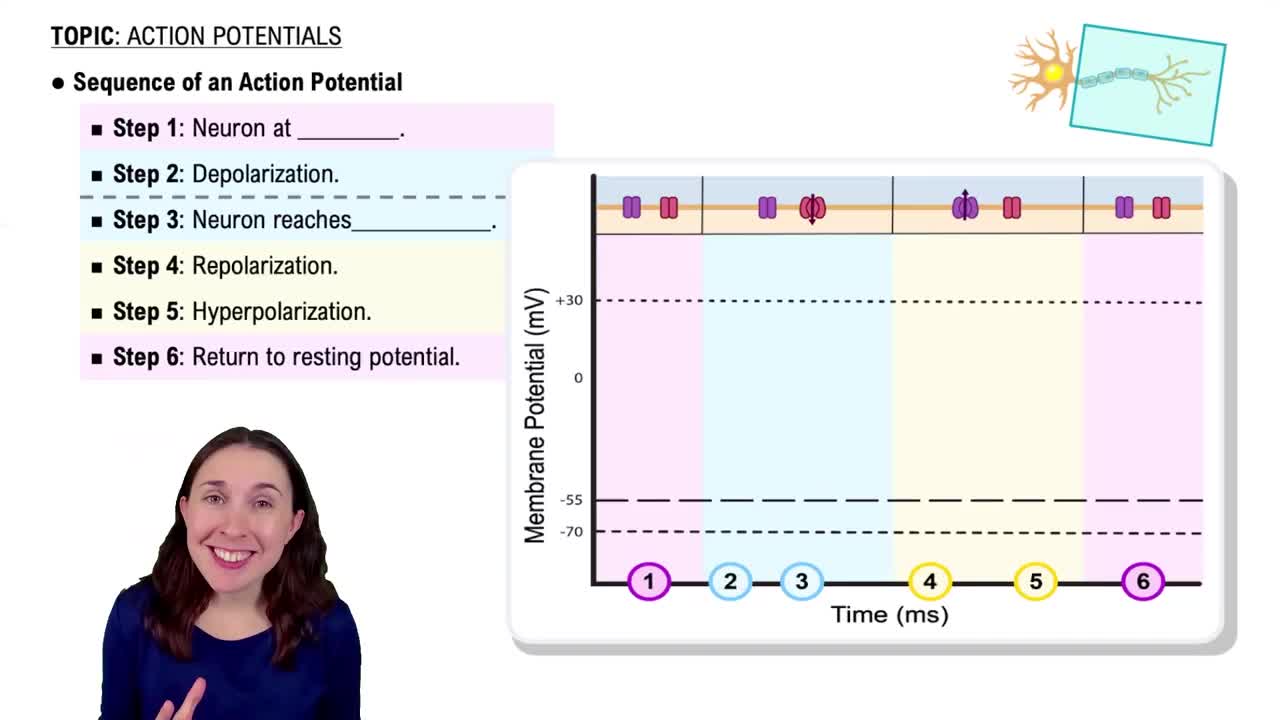
Understand the process of action potential generation in skeletal muscle cells, which involves changes in membrane permeability to specific ions.
Recall that during the depolarization phase of the action potential, the membrane becomes permeable to sodium ions, allowing them to enter the cell.
Recognize that calcium ions play a role in muscle contraction but do not primarily enter the cell during the initial action potential generation.
Note that chloride ions generally help stabilize the resting membrane potential and do not enter the cell during the action potential.
Remember that potassium ions exit the cell during repolarization, not enter during the generation of the action potential.

Risposta video verificata per un problema simile:

Questa soluzione video è stata consigliata dai nostri tutor come utile per risolvere questo problema.
Durata del video:
3m

Concetti chiave

Ecco i concetti essenziali che devi comprendere per rispondere correttamente alla domanda.

Action Potential in Skeletal Muscle

An action potential in skeletal muscle is a rapid change in membrane potential that triggers muscle contraction. It involves the movement of ions across the muscle cell membrane, leading to depolarization and repolarization phases essential for signal transmission.
Video consigliato:
03:53
Action Potential

Role of Sodium Ions (Na⁺) in Depolarization

During the initiation of an action potential, sodium channels open, allowing Na⁺ ions to enter the muscle cell. This influx causes the membrane potential to become more positive, leading to depolarization, which is the key step in generating the action potential.
Video consigliato:
01:55
Ions - Sodium and Potassium Example 3

Role of Potassium Ions (K⁺) in Repolarization

After depolarization, potassium channels open to allow K⁺ ions to exit the cell, restoring the negative resting membrane potential. This efflux of K⁺ ions is crucial for repolarization, helping the muscle cell return to its resting state after an action potential.
Video consigliato:
01:55
Ions - Sodium and Potassium Example 3
Pratica correlata
Domanda del libro di testo

The neurotransmitter released by somatic motor neurons is:

a. Acetylcholine

b. Acetylcholinesterase

c. Norepinephrine

1510
views
2
rank
Domanda del libro di testo

The smooth muscle type found in the walls of digestive and urinary system organs and that exhibits gap junctions and pacemaker cells is:

a. Multi unit

b. Unitary

885
views
1
rank
Domanda del libro di testo

Aerobic exercise results in all of the following except:

a. More capillaries surrounding muscle fibers

b. More mitochondria in muscle cells

c. Increased size and strength of existing muscle cells

d. More myoglobin

1448
views
1
rank
Domanda del libro di testo

Characteristics of isometric contractions include all but:

a. Shortening

b. Increased muscle tension throughout the contraction phase

c. Absence of shortening

d. Used in resistance training

1139
views
1
rank
Domanda del libro di testo

Myoglobin has a special function in muscle tissue. It:

a. Breaks down glycogen

b. Is a contractile protein

c. Holds a reserve supply of oxygen in the muscle

1093
views
1
rank
Domanda del libro di testo

During muscle contraction, ATP is provided by:

a. a coupled reaction of creatine phosphate with ADP

b. aerobic respiration of glucose, and

c. anaerobic glycolysis.

______ (1) Which provides ATP fastest?

______  (2) Which does (do) not require that oxygen be available?

______  (3) Which provides the highest yield of ATP per glucose molecule?

______  (4) Which results in the formation of lactic acid?

______  (5) Which has carbon dioxide and water products?

______  (6) Which is most important in endurance sports?

1469
views
2
rank