Ch. 12 The Lymphatic System and Body Defenses
Marieb - Essentials of Human Anatomy & Physiology 13th Edition
Marieb13th EditionEssentials of Human Anatomy & PhysiologyISBN: 9780135624340Non è quello che usi tu?Cambia libro di testo
Capitolo 12, Problema 18

Binding of antigens to receptors of immunocompetent lymphocytes leads to clonal selection. Describe the process of clonal selection. What nonlymphocyte cell is a central actor in this process, and what is its function?

Guida verificata passo dopo passo
1
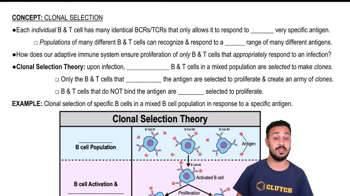
Clonal selection begins when an antigen binds to a specific receptor on the surface of an immunocompetent lymphocyte (either a B cell or T cell). This binding activates the lymphocyte, signaling it to proliferate and differentiate.
The activated lymphocyte undergoes rapid mitosis, producing a population of identical cells (clones) that all recognize the same antigen. This ensures a robust immune response to the specific pathogen or foreign substance.
The clones differentiate into two main types: effector cells and memory cells. Effector cells actively participate in the immune response by producing antibodies (in the case of B cells) or directly attacking infected cells (in the case of cytotoxic T cells). Memory cells remain in the body to provide long-term immunity by quickly responding to future encounters with the same antigen.
A nonlymphocyte cell central to this process is the antigen-presenting cell (APC), such as a dendritic cell or macrophage. APCs engulf and process the antigen, then present fragments of it on their surface using major histocompatibility complex (MHC) molecules.
The function of the APC is to activate helper T cells by presenting the antigen-MHC complex to their receptors. Helper T cells then release cytokines that further stimulate the proliferation and differentiation of B cells and cytotoxic T cells, amplifying the immune response.

Risposta video verificata per un problema simile:

Questa soluzione video è stata consigliata dai nostri tutor come utile per risolvere questo problema.
Durata del video:
2m

Concetti chiave

Ecco i concetti essenziali che devi comprendere per rispondere correttamente alla domanda.

Clonal Selection

Clonal selection is a fundamental process in the adaptive immune response where specific lymphocytes (B cells and T cells) are activated upon binding to their corresponding antigens. This binding triggers the proliferation of these lymphocytes, resulting in a clone of cells that can effectively target the specific pathogen. The selected cells then differentiate into effector cells, which carry out the immune response, and memory cells, which provide long-term immunity.
Video consigliato:
Percorso guidato
6:43
Clonal Selection

Immunocompetent Lymphocytes

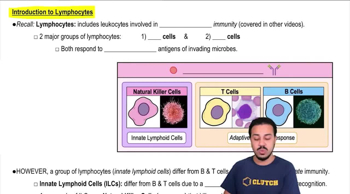
Immunocompetent lymphocytes are mature lymphocytes that have the ability to recognize and respond to specific antigens. B cells produce antibodies, while T cells can directly kill infected cells or help other immune cells. Their development occurs in the bone marrow and thymus, and they circulate throughout the body, ready to respond to pathogens. The specificity of these cells is determined by their unique receptors that bind to specific antigens.
Video consigliato:

Dendritic Cells

Dendritic cells are a type of antigen-presenting cell (APC) that play a crucial role in the process of clonal selection. They capture, process, and present antigens to T cells in the lymph nodes, thereby activating them. Dendritic cells are essential for initiating the adaptive immune response, as they help bridge the innate and adaptive immunity by informing lymphocytes about the presence of pathogens and guiding their activation and differentiation.
Video consigliato:
Percorso guidato
02:10
The Epidermis: Cells Example 2