Ch. 6 The Muscular System
Marieb - Essentials of Human Anatomy & Physiology 13th Edition
Marieb13th EditionEssentials of Human Anatomy & PhysiologyISBN: 9780135624340Non è quello che usi tu?Cambia libro di testo
Capitolo 6, Problema 20

Chemical A binds and blocks acetylcholine receptors of muscle cells. Chemical B floods the cytoplasm of muscle cells with calcium ions. Which chemical would make the best muscle relaxant, and why?

Guida verificata passo dopo passo
1
Step 1: Understand the role of acetylcholine in muscle contraction. Acetylcholine is a neurotransmitter that binds to receptors on the muscle cell membrane, triggering an action potential that leads to calcium ion release and muscle contraction.
Step 2: Analyze the effect of Chemical A. Chemical A blocks acetylcholine receptors, preventing acetylcholine from binding. This stops the initiation of the action potential, thereby halting calcium ion release and muscle contraction.
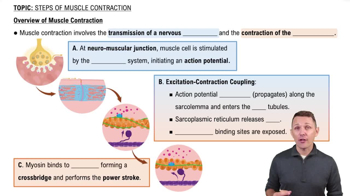
Step 3: Examine the role of calcium ions in muscle contraction. Calcium ions bind to troponin, causing a conformational change that exposes binding sites on actin for myosin, enabling muscle contraction.
Step 4: Evaluate the effect of Chemical B. Chemical B floods the cytoplasm with calcium ions, which would promote continuous muscle contraction rather than relaxation, as calcium is essential for the contraction process.
Step 5: Compare the two chemicals. Chemical A would be the better muscle relaxant because it prevents the initiation of muscle contraction by blocking acetylcholine receptors, whereas Chemical B would exacerbate contraction by increasing calcium ion levels.

Risposta video verificata per un problema simile:

Questa soluzione video è stata consigliata dai nostri tutor come utile per risolvere questo problema.
Durata del video:
1m

Concetti chiave

Ecco i concetti essenziali che devi comprendere per rispondere correttamente alla domanda.

Acetylcholine Receptors

Acetylcholine receptors are proteins located on the surface of muscle cells that bind the neurotransmitter acetylcholine, leading to muscle contraction. When these receptors are activated, they allow sodium ions to enter the cell, triggering a cascade that results in muscle contraction. Blocking these receptors prevents muscle contraction, making it a key target for muscle relaxants.
Video consigliato:
2:47
Sensory Receptors

Calcium Ions in Muscle Contraction

Calcium ions play a crucial role in muscle contraction by facilitating the interaction between actin and myosin filaments within muscle fibers. When calcium is released into the cytoplasm, it binds to troponin, causing a conformational change that allows myosin to bind to actin, resulting in contraction. Flooding the cytoplasm with calcium ions would enhance contraction rather than relaxation.
Video consigliato:
4:53
Overview of Muscle Contraction

Mechanism of Muscle Relaxants

Muscle relaxants work by interfering with the neuromuscular transmission or by directly affecting the muscle fibers. Effective muscle relaxants typically block acetylcholine receptors or inhibit calcium release, leading to reduced muscle tone and relaxation. In this context, a chemical that blocks acetylcholine receptors would be more effective as a muscle relaxant compared to one that increases calcium levels.
Video consigliato:
2:00
Introduction to Muscles and Muscle Tissue Example 1
Pratica correlata
Domanda del libro di testo

When Eric returned from jogging, he was breathing heavily and sweating profusely, and he complained that his legs ached and felt weak. On the basis of what you have learned about muscle energy metabolism, respond to the following questions:

b. What ATP-harvesting pathway have his working muscles been using that leads to such a breathing pattern?

677
views
Domanda del libro di testo

Michael had a nervous habit of chewing on the inner lining of his lip with his front teeth. The lip grew thicker and thicker from years of continual irritation. Michael's dentist noticed his greatly thickened lip, then told him to have it checked to see if the thickening was a tumor. A biopsy revealed hyperplasia, but no evidence of neoplasia. What do these terms mean? Did Michael have cancer of the mouth?

735
views
Domanda del libro di testo

When Eric returned from jogging, he was breathing heavily and sweating profusely, and he complained that his legs ached and felt weak. On the basis of what you have learned about muscle energy metabolism, respond to the following questions: c. What metabolic product(s) might account for his sore muscles and his feeling of muscle weakness?

653
views
Domanda del libro di testo

When Eric returned from jogging, he was breathing heavily and sweating profusely, and he complained that his legs ached and felt weak. On the basis of what you have learned about muscle energy metabolism, respond to the following questions:

a. Why is Eric breathing heavily?

668
views