Ch. 13 The Peripheral Nervous System and Reflex Activity
Marieb - Human Anatomy & Physiology 7th Edition
Marieb, Hoehn7th EditionHuman Anatomy & PhysiologyISBN: 9780805359091Non è quello che usi tu?Cambia libro di testo
Capitolo 13, Problema 4

Match the names of the cranial nerves in column B to the appropriate description in column A.
Column A 
_______    (1) Causes pupillary constriction 
_______    (2) The major sensory nerve of the face
_______    (3) Serves the sternocleido-mastoid and trapezius muscles 
_______    (4) Purely sensory (two nerves) 
_______    (5) Serves the tongue muscles 
_______    (6) Allows you to chew your food 
_______    (7) Impaired in Bell's palsy
_______    (8) Helps regulate heart activity
_______    (9) Helps you hear and maintain your balance 
_______   (10) Contain parasympathetic motor fibers (four nerves)
Column B
a. Abducens
b. Accessory
c. Facial
d. Glossopharyngeal
e. Hypoglossal
f. Oculomotor
g. Olfactory
h. Optic
i. Trigeminal
j. Trochlear
k. Vagus
l. Vestibulocochlear

Guida verificata passo dopo passo
1
Step 1: Identify the cranial nerve responsible for pupillary constriction. This function is typically associated with parasympathetic fibers controlling the iris muscles, which is a key role of the Oculomotor nerve. So, match (1) with the Oculomotor nerve (f).
Step 2: Determine the major sensory nerve of the face. The Trigeminal nerve is known as the primary sensory nerve for the face, providing sensation to the skin and mucous membranes. Match (2) with the Trigeminal nerve (i).
Step 3: Find the nerve that serves the sternocleidomastoid and trapezius muscles. These muscles are innervated by the Accessory nerve, which controls certain neck and shoulder movements. Match (3) with the Accessory nerve (b).
Step 4: Identify the purely sensory cranial nerves. Among the options, the Olfactory nerve (smell) and the Optic nerve (vision) are purely sensory. Match (4) with Olfactory (g) and Optic (h).
Step 5: For the remaining descriptions, use knowledge of cranial nerve functions: (5) tongue muscles are served by the Hypoglossal nerve (e); (6) chewing is controlled by the Trigeminal nerve (i); (7) Bell's palsy affects the Facial nerve (c); (8) heart regulation involves the Vagus nerve (k); (9) hearing and balance are functions of the Vestibulocochlear nerve (l); and (10) parasympathetic motor fibers are found in four nerves including Oculomotor (f), Facial (c), Glossopharyngeal (d), and Vagus (k).

Risposta video verificata per un problema simile:

Questa soluzione video è stata consigliata dai nostri tutor come utile per risolvere questo problema.

Concetti chiave

Ecco i concetti essenziali che devi comprendere per rispondere correttamente alla domanda.

Functions of Cranial Nerves

Cranial nerves have specific sensory, motor, or mixed functions that control various head and neck activities. Understanding their roles, such as sensory input from the face or motor control of muscles, is essential for matching nerves to their descriptions.
Video consigliato:
8:20
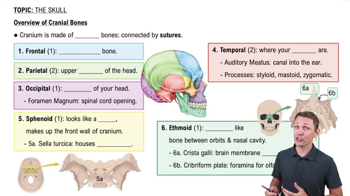
Overview of Cranial Bones

Parasympathetic Innervation by Cranial Nerves

Some cranial nerves carry parasympathetic fibers that regulate involuntary functions like pupil constriction and heart rate. Identifying which nerves contain these fibers helps in linking them to autonomic functions described in the question.
Video consigliato:
0:56
Parasympathetic Nervous System Example 2

Clinical Associations of Cranial Nerves

Certain cranial nerves are linked to clinical conditions, such as Bell's palsy affecting the facial nerve. Recognizing these associations aids in correctly identifying nerves based on symptoms or impairments mentioned.
Video consigliato:
8:20
Overview of Cranial Bones
Pratica correlata
Domanda del libro di testo

The large onion-shaped receptors that are found deep in the dermis and in subcutaneous tissue and that respond to deep pressure are

a. Epithelial tactile complexes

b. Lamellar corpuscles

c. Free nerve endings

d. Muscle spindles

1008
views
Domanda del libro di testo

The portion of the fibrous layer that is white and opaque is the

a. Choroid

b. Cornea

c. Retina

d. Sclera

138
views
Domanda del libro di testo

Proprioceptors include all of the following except

a. Muscle spindles

b. Tendon organs

c. Epithelial tactile complexes

d. Joint kinesthetic receptors

1491
views
Domanda del libro di testo

The connective tissue sheath that surrounds a fascicle of nerve fibers is the

a. Epineurium

b. Endoneurium

c. Perineurium

d. Epimysium

1461
views
Domanda del libro di testo

Accessory glands that produce an oily secretion are the

a. Conjunctiva

b. Lacrimal glands

c. Tarsal glands

159
views
Domanda del libro di testo

Match the receptor type in column B to the correct description in column A.

Column A

______    (1) Pain, itch, and temperature receptors

______    (2) Contains intrafusal fibers and anulospiral and flower spray endings

______    (3) Discriminative touch receptor in hairless skin (fingertips)

______    (4) Contains receptor endings wrapped around thick collagen bundles

______    (5) Rapidly adapting deep-pressure receptor

______    (6) Slowly adapting deep-pressure receptor

Column B

a. Bulbous corpuscles

b. Tendon organ

c. Muscle spindle

d. Free nerve endings

e. Lamellar corpuscle

f. Tactile corpuscle

935
views