Ch. 17 Blood
Marieb - Human Anatomy & Physiology 7th Edition
Marieb, Hoehn7th EditionHuman Anatomy & PhysiologyISBN: 9780805359091Non è quello che usi tu?Cambia libro di testo
Capitolo 16, Problema 3

All of the following are true of RBCs except:
a. Biconcave disc shape
b. Life span of approximately 120 days
c. Contain hemoglobin
d. Contain nuclei

Guida verificata passo dopo passo
1
Step 1: Understand the structure and function of red blood cells (RBCs). RBCs are specialized cells primarily responsible for transporting oxygen throughout the body using hemoglobin.
Step 2: Recall that RBCs have a distinctive biconcave disc shape, which increases their surface area for gas exchange and allows flexibility to pass through narrow capillaries.
Step 3: Remember that mature RBCs do not contain nuclei. This absence allows more room for hemoglobin, maximizing oxygen-carrying capacity.
Step 4: Note that RBCs have a typical lifespan of about 120 days, after which they are removed from circulation and recycled by the spleen and liver.
Step 5: Based on these facts, identify which statement is false by comparing each option to the known characteristics of RBCs, focusing especially on the presence or absence of nuclei.

Risposta video verificata per un problema simile:

Questa soluzione video è stata consigliata dai nostri tutor come utile per risolvere questo problema.
Durata del video:
2m

Concetti chiave

Ecco i concetti essenziali che devi comprendere per rispondere correttamente alla domanda.

Red Blood Cell (RBC) Structure

RBCs have a distinctive biconcave disc shape that increases their surface area for efficient gas exchange. This shape also allows them to deform as they pass through narrow capillaries. Unlike many other cells, mature RBCs lack a nucleus to maximize space for hemoglobin.
Video consigliato:
Percorso guidato
14:36
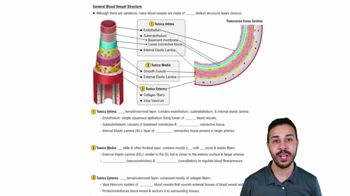
General Blood Vessel Structure

RBC Lifespan

The average lifespan of a red blood cell is about 120 days. After this period, RBCs are typically removed from circulation by the spleen and liver. This lifespan is important for maintaining healthy oxygen transport and for the turnover of old or damaged cells.
Video consigliato:
Percorso guidato
2:52
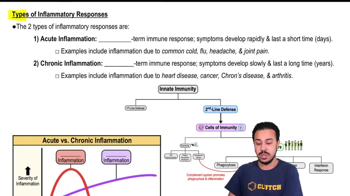
Types of Inflammatory Response

Hemoglobin Function in RBCs

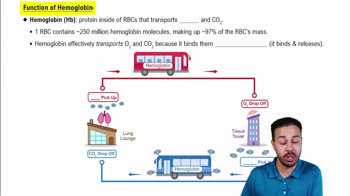
Hemoglobin is the iron-containing protein in RBCs responsible for binding and transporting oxygen from the lungs to tissues. It also carries carbon dioxide back to the lungs for exhalation. The presence of hemoglobin is essential for the primary function of RBCs in gas exchange.
Video consigliato:
Percorso guidato
7:52
Function of Hemoglobin