Explain the reasons for the observed changes in blood flow velocity in the different regions of the circulation.
Ch. 19 The Cardiovascular System: Blood Vessels

Marieb, Hoehn7th EditionHuman Anatomy & PhysiologyISBN: 9780805359091Non è quello che usi tu?Cambia libro di testo
Tutti i libri di testo
Marieb, Hoehn 7th Edition
Ch. 19 The Cardiovascular System: Blood Vessels
Problema 19
Marieb, Hoehn 7th Edition
Ch. 19 The Cardiovascular System: Blood Vessels
Problema 19Capitolo 18, Problema 19
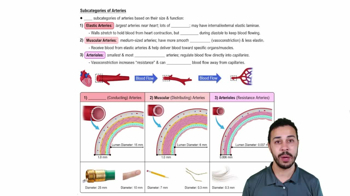
Distinguish between elastic arteries, muscular arteries, and arterioles relative to location, histology, and functional adaptations.
Guida verificata passo dopo passo1
Step 1: Define each type of artery by location. Elastic arteries are the largest arteries closest to the heart (e.g., aorta), muscular arteries are medium-sized arteries distributing blood to specific organs, and arterioles are the smallest arteries leading into capillary beds.
Step 2: Describe the histological features of elastic arteries. They have a thick tunica media rich in elastic fibers, allowing them to stretch and recoil with each heartbeat to maintain blood pressure.
Step 3: Explain the histology of muscular arteries. These arteries have a tunica media dominated by smooth muscle cells, enabling them to regulate blood flow by vasoconstriction and vasodilation.
Step 4: Characterize arterioles histologically. Arterioles have a thin tunica media with only a few layers of smooth muscle cells, which allows them to control blood flow into capillaries and regulate systemic blood pressure.
Step 5: Summarize the functional adaptations. Elastic arteries act as pressure reservoirs, muscular arteries distribute blood and regulate flow to organs, and arterioles serve as primary resistance vessels controlling blood flow and pressure at the microcirculatory level.

Risposta video verificata per un problema simile:
Questa soluzione video è stata consigliata dai nostri tutor come utile per risolvere questo problema.
Durata del video:
2mConcetti chiave
Ecco i concetti essenziali che devi comprendere per rispondere correttamente alla domanda.
Elastic Arteries
Elastic arteries are large vessels near the heart, such as the aorta, characterized by a thick tunica media rich in elastic fibers. This elasticity allows them to stretch during systole and recoil during diastole, helping to maintain continuous blood flow and dampen pressure fluctuations.
Video consigliato:
Percorso guidato
Subcategories of Arteries
Muscular Arteries
Muscular arteries are medium-sized arteries located further from the heart, with a tunica media dominated by smooth muscle cells rather than elastic fibers. This structure enables them to regulate blood flow by vasoconstriction and vasodilation, directing blood to specific organs as needed.
Video consigliato:
Percorso guidato
Subcategories of Arteries
Arterioles
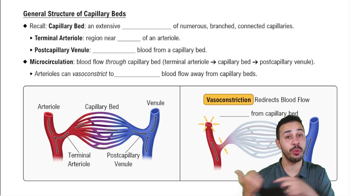
Arterioles are small vessels that lead into capillary beds, with a thin tunica media primarily composed of smooth muscle. They play a key role in controlling blood pressure and flow resistance through their ability to constrict or dilate, thus regulating microcirculation and tissue perfusion.
Video consigliato:
Percorso guidato
General Structure of Capillary Beds
Pratica correlata
Domanda del libro di testo
1032
views
Domanda del libro di testo
Physiologists often consider capillaries and postcapillary venules together.
a. What functions do these vessels share?
b. Structurally, how do they differ?
1213
views
Domanda del libro di testo
a. What blood vessels contribute to the formation of the hepatic portal circulation?
b. Why is a portal circulation a 'strange' circulation
957
views
Domanda del libro di testo
How does the control of blood flow to the skin for the purpose of regulating body temperature differ from the control of nutrient blood flow to skin cells?
869
views
1
rank
Domanda del libro di testo
Write an equation showing the relationship between total peripheral resistance, blood flow, and blood pressure.
89
views
Domanda del libro di testo
How are nutrients, wastes, and respiratory gases transported to and from the blood and tissue spaces?
1178
views