Ch. 22 The Respiratory System
Marieb - Human Anatomy & Physiology 7th Edition
Marieb, Hoehn7th EditionHuman Anatomy & PhysiologyISBN: 9780805359091Non è quello che usi tu?Cambia libro di testo
Capitolo 21, Problema 17

Define hyperventilation
If you hyperventilate, do you retain or expel more carbon dioxide?
What effect does hyperventilation have on blood pH?

Guida verificata passo dopo passo
1
Step 1: Define hyperventilation by explaining that it is a condition characterized by breathing at an abnormally rapid rate, which increases the amount of air entering the lungs.
Step 2: Understand the effect of hyperventilation on carbon dioxide levels by recognizing that rapid breathing causes more carbon dioxide (CO\_2) to be expelled from the body than normal.
Step 3: Explain that because CO\_2 is expelled more quickly, its concentration in the blood decreases, a condition known as hypocapnia.
Step 4: Connect the decrease in CO\_2 to blood pH by noting that CO\_2 reacts with water in the blood to form carbonic acid, so less CO\_2 means less carbonic acid and thus a rise in blood pH (making the blood more alkaline).
Step 5: Summarize that hyperventilation leads to expelling more CO\_2, which causes blood pH to increase, resulting in respiratory alkalosis.

Risposta video verificata per un problema simile:

Questa soluzione video è stata consigliata dai nostri tutor come utile per risolvere questo problema.

Concetti chiave

Ecco i concetti essenziali che devi comprendere per rispondere correttamente alla domanda.

Hyperventilation

Hyperventilation is the condition of breathing at an abnormally rapid rate, which increases the amount of air entering the lungs. This leads to excessive expulsion of carbon dioxide from the bloodstream, disrupting normal gas exchange.
Video consigliato:
6:07
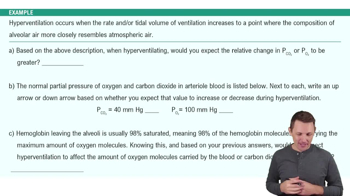
Respiration Example 2

Carbon Dioxide Expulsion During Hyperventilation

During hyperventilation, more carbon dioxide is expelled from the body than usual because of the increased breathing rate. This reduces the partial pressure of CO2 in the blood, affecting the body's acid-base balance.
Video consigliato:

Effect of Hyperventilation on Blood pH

Hyperventilation causes a decrease in blood carbon dioxide levels, which leads to respiratory alkalosis—a rise in blood pH. This makes the blood more alkaline, potentially causing symptoms like dizziness or tingling.
Video consigliato:
Pratica correlata
Domanda del libro di testo

Differentiate clearly between minute ventilation and alveolar ventilation rate

Which provides a more accurate measure of ventilatory efficiency, and why?

1384
views
Domanda del libro di testo

The bulk of carbon dioxide is carried:

a. Chemically combined with the amino acids of hemoglobin as carbaminohemoglobin in the red blood cells

b. As the ion HCO₃⁻ in the plasma after first entering the red blood cell

c. As carbonic acid in the plasma

d. Chemically combined with the heme portion of Hb

107
views
Domanda del libro di testo

Daniel, the swimmer with the fastest time on the Springfield College swim team, routinely hyperventilates before a meet, as he says, 'to sock some more oxygen into my lungs so I can swim longer without having to breathe.' First of all, what basic fact about oxygen loading has Daniel forgotten (a lapse leading to false thinking)? Second, how is Daniel jeopardizing not only his time but his life?

97
views
Domanda del libro di testo

Describe the functional relationships between volume changes and gas flow into and out of the lungs.

1119
views
Domanda del libro di testo

A member of the 'Blues' gang was rushed into an emergency room after receiving a knife wound in the left side of his thorax. The diagnosis was pneumothorax and a collapsed lung. Explain exactly

Why the lung collapsed?

Why only one lung (not both) collapsed?

944
views
Domanda del libro di testo

Briefly explain the anatomical 'reason' why most men have deeper voices than boys or women.

114
views