Ch. 26 Fluid, Electrolyte, and Acid-Base Balance
Marieb - Human Anatomy & Physiology 7th Edition
Marieb, Hoehn7th EditionHuman Anatomy & PhysiologyISBN: 9780805359091Non è quello che usi tu?Cambia libro di testo
Capitolo 25, Problema 5

Two main substances regulated by the influence of aldosterone on the kidney tubules are:
a. Ammonium ions
b. Bicarbonate
c. Calcium
d. Chloride
e. Hydrogen ions
f. Magnesium
g. Phosphate
h. Potassium
i. Sodium
j. Water

Guida verificata passo dopo passo
1
Understand the role of aldosterone in the kidney: Aldosterone is a hormone that primarily acts on the distal tubules and collecting ducts of the nephron to regulate electrolyte balance and blood pressure.
Identify the main ions influenced by aldosterone: Aldosterone increases the reabsorption of sodium ions (Na\(\textsuperscript{+}\)) from the tubular fluid back into the bloodstream, which helps retain sodium and water, thus increasing blood volume and pressure.
Recognize the secondary effect on potassium: Aldosterone promotes the secretion of potassium ions (K\(\textsuperscript{+}\)) into the tubular fluid, which leads to potassium excretion in the urine.
Exclude other substances: While other ions like calcium, magnesium, phosphate, chloride, hydrogen ions, ammonium, bicarbonate, and water are regulated by different mechanisms or hormones, aldosterone specifically targets sodium and potassium balance.
Conclude that the two main substances regulated by aldosterone in the kidney tubules are sodium (Na\(\textsuperscript{+}\)) and potassium (K\(\textsuperscript{+}\)).

Risposta video verificata per un problema simile:

Questa soluzione video è stata consigliata dai nostri tutor come utile per risolvere questo problema.
Durata del video:
6m

Concetti chiave

Ecco i concetti essenziali che devi comprendere per rispondere correttamente alla domanda.

Aldosterone and its Role in Kidney Function

Aldosterone is a steroid hormone produced by the adrenal cortex that regulates electrolyte and fluid balance by acting on kidney tubules. It primarily increases sodium reabsorption and potassium excretion, helping to maintain blood pressure and volume. Understanding aldosterone’s mechanism is key to identifying which substances it influences.
Video consigliato:
3:44
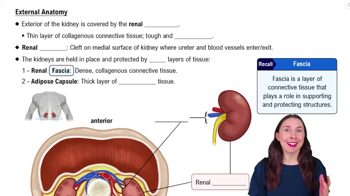
External Anatomy

Sodium Reabsorption in the Kidney

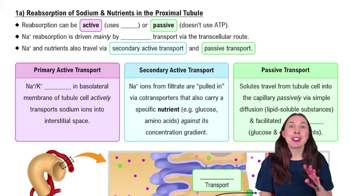
Sodium reabsorption occurs mainly in the distal tubules and collecting ducts of the nephron, where aldosterone stimulates sodium channels and sodium-potassium pumps. This process conserves sodium in the body, which is crucial for maintaining extracellular fluid volume and blood pressure.
Video consigliato:
6:51
1a) Reabsorption of Sodium & Nutrients in the Proximal Tubule

Potassium Secretion in the Kidney

Aldosterone promotes potassium secretion into the tubular lumen in exchange for sodium reabsorption. This regulation helps maintain potassium homeostasis, preventing hyperkalemia or hypokalemia, which are critical for normal cellular function, especially in muscles and nerves.
Video consigliato:
1:00
The Kidneys Example 1