Ch. 27 The Reproductive System
Marieb - Human Anatomy & Physiology 7th Edition
Marieb, Hoehn7th EditionHuman Anatomy & PhysiologyISBN: 9780805359091Non è quello che usi tu?Cambia libro di testo
Capitolo 26, Problema 2

Relative to differences between mitosis and meiosis, choose the statements that apply only to events of meiosis:
a. Tetrads present
b. Produces two daughter cells
c. Produces four daughter cells
d. Occurs throughout life
e. Reduces the chromosomal number by half
f. Synapsis and crossing over of homologous occur

Guida verificata passo dopo passo
1
Step 1: Understand the key differences between mitosis and meiosis. Mitosis results in two genetically identical daughter cells, while meiosis results in four genetically diverse daughter cells and includes unique processes such as synapsis and crossing over.
Step 2: Identify which statements describe features unique to meiosis. For example, the presence of tetrads (paired homologous chromosomes) occurs only during meiosis, specifically in prophase I.
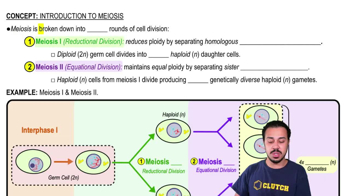
Step 3: Recognize that meiosis produces four daughter cells, not two, which is a key difference from mitosis.
Step 4: Note that meiosis reduces the chromosome number by half, producing haploid cells from a diploid parent, which is essential for sexual reproduction.
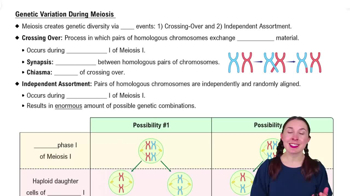
Step 5: Understand that synapsis and crossing over of homologous chromosomes are unique to meiosis and contribute to genetic variation, whereas mitosis does not involve these processes.

Risposta video verificata per un problema simile:

Questa soluzione video è stata consigliata dai nostri tutor come utile per risolvere questo problema.
Durata del video:
2m

Concetti chiave

Ecco i concetti essenziali che devi comprendere per rispondere correttamente alla domanda.

Tetrads and Synapsis in Meiosis

During meiosis, homologous chromosomes pair up to form tetrads in a process called synapsis. This pairing allows crossing over, where genetic material is exchanged, increasing genetic diversity. These events are unique to meiosis and do not occur in mitosis.
Video consigliato:
5:19
Genetic Variation During Meiosis

Reduction of Chromosome Number

Meiosis reduces the chromosome number by half, producing haploid cells from a diploid parent. This reduction is essential for sexual reproduction, ensuring that when gametes fuse, the resulting offspring have the correct chromosome number.
Video consigliato:
Percorso guidato
4:49
Meiosis I & Meiosis II

Number of Daughter Cells Produced

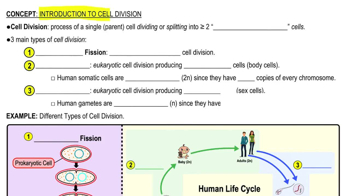
Meiosis results in four genetically distinct daughter cells, each with half the chromosome number of the original cell. In contrast, mitosis produces two identical daughter cells, maintaining the chromosome number.
Video consigliato:
Percorso guidato
09:40
Introduction to Cell Division